

bill of indictment
 1
8.6
1
8.6

- noun
- /bɪl əv ɪnˈdaɪktmənt/
- Formal
- Urdangarn was summoned to appear at the Palma de Mallorca court twice during February of this year, and a bill of indictment was issued against him (under the Spanish legal system, this is one step before a formal criminal accusation).
Examples
-
In fact, the Israeli judiciary no longer shows any concern for the fulfillment of the formal conditions for legal prosecutions, such as a trial in the presence of judges and counsel for the prosecution and the defense, with case files, bills of indictment, and a clearly specified time at which all the parties must appear in court.
Academic text (1990) -
The prosecutor presented evidence to the grand jury to obtain a bill of indictment against the suspect.
-
The shorter that bill of indictment, the better.
Academic text (2006) -
That said, it is a bill of indictment against the post-V2 Church when most Catholics don't follow Catholic moral teaching.
Blog text (16) -
After reviewing the case details, the grand jury issued a bill of indictment for the suspected embezzler.
-
The bill of indictment outlined the charges of theft and fraud against the accused.
Synonyms
 ∞
6.0
∞
6.0
An official accusation of a crime
 271
7.8
271
7.8
A formal charge of a crime or a strong statement that criticizes someone
 2
5.4
2
5.4
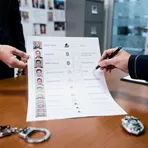
A written list of charges and arrests at a police station
Antonyms


Surface Forms
Morphology
bill + of + indictment
The noun 'indictment' already carries the core meaning of a formal criminal charge, and if a learner knows 'bill' in the general sense of a written document, they can plausibly infer 'bill of indictment' means a written charging document. However, 'bill' is more frequently known to learners as a legislative proposal and the phrase is legalistic/less common, so the exact sense may not be fully predictable without exposure.
Etymology
Bill of indictment The noun bill of indictment comes from the idea that a bill is a written paper listing accusations and an indictment is an official charge. Imagine a sheet of paper that names the crimes and 'officially charges' someone, so that's why the phrase means an official written charge used to start a criminal case.