
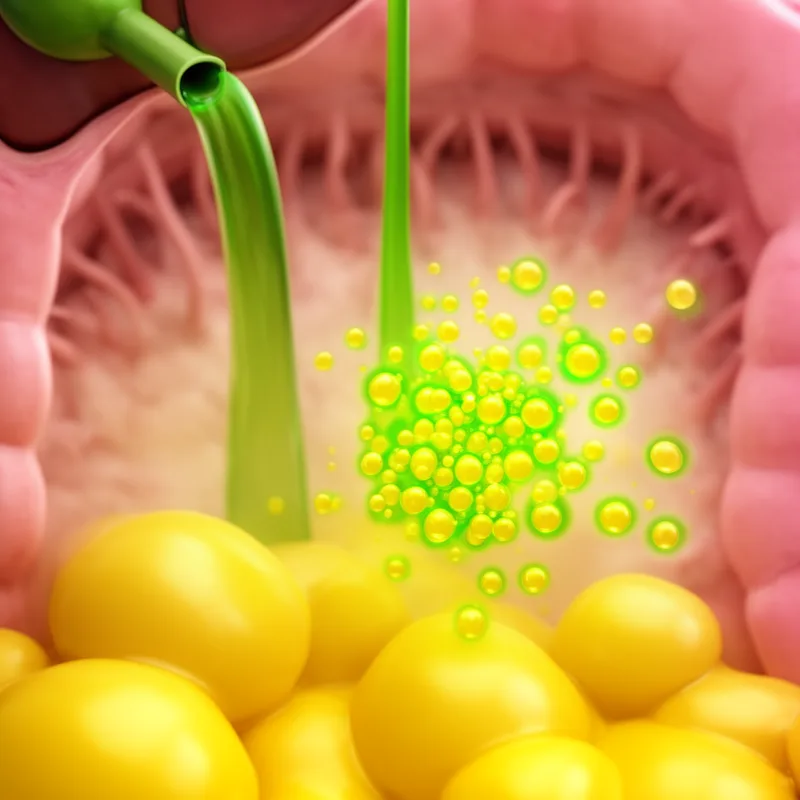
bile salt


 1
4.8
1
4.8
- noun
- /baɪl sɔlt/
- Specialized
- Some of the newly produced cholesterol is converted into bile salts (necessary for fat absorption), and some enters the circulation.
Examples
-
Without bile salts, the absorption of dietary fats would be significantly impaired.
-
During digestion, bile salts help emulsify lipids for better absorption.
-
Actually, our bodies require cholesterol for making bile salts.
Blog text (32) -
All that acid in your stomach and those bile salts in your colon.
Fiction book (1998) -
Both bile salts and cholesterol are excreted via bile to the intestines, where they are available for reabsorption. This recycling process is known as 'entero-hepatic circulation.'
Academic text (2011) -
The bile salts produced by the liver play a crucial role in digesting fats.
Surface Forms
Morphology
The term denotes a salt derived from bile (i.e., a bile acid), so its meaning is directly composed from the constituents 'bile' + 'salt'. The noun–noun composition follows a common pattern (X salt = the salt of X) that is cross-linguistically regular, making the meaning inferable to a B1 learner who knows both words.
Etymology
Bile salt is named for what it does: bile is the bitter fluid from the liver and salt shows it is a kind of salt. Like soap, bile salts break large fat pieces into tiny drops so the body can 'digest' and 'absorb' them, which is why they 'help digest fats'.