
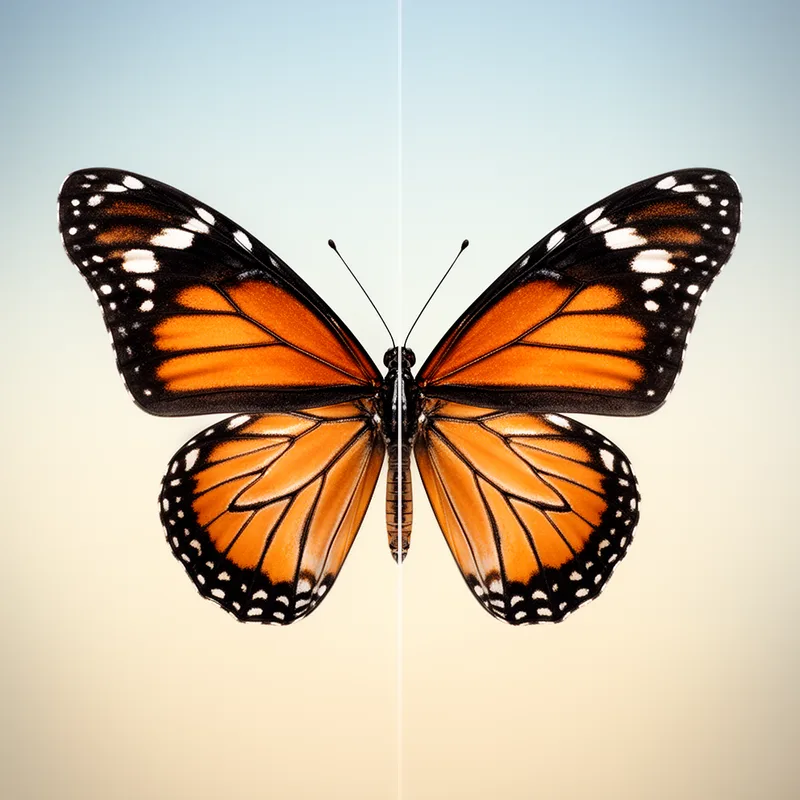
bilaterally symmetrical
- adjective
- /baɪˈlætərəli sɪˈmɛtrɪkəl/
- Specialized
- Like many creatures, scorpion flies are bilaterally symmetrical, with three legs and two membranous wings on each side of the body.
Examples
-
They were bilaterally symmetrical about a horizontal axis drawn across the middle of their shells, with three limbs on each side of the axis.
Fiction book (1998) -
Bilaterally symmetrical flowers, such as snapdragons and sweet peas, have distinctive upper and lower petals and are therefore asymmetric from top to bottom.
Academic text (2002) -
Insects and vertebrates are both bilaterally symmetrical and composed of repeated parts.
Academic text (1992) -
But for organisms that have evolved bilaterally symmetrical body traits, asymmetry may be an indication that something has gone awry.
Academic text (1993) -
Humans and other vertebrates are bilaterally symmetrical: our left side is a mirror image of the right.
-
Like many creatures, scorpion flies are bilaterally symmetrical, with three legs and two membranous wings on each side of the body.
-
The test itself consists of 10 cards with bilaterally symmetrical images, five black and white, and five in color.
Synonyms

 25
4.1
25
4.1

A shape or object that has matching parts on both sides when you cut it down the middle
 6
4.3
6
4.3
The same on both sides when split down the middle
 2
5.7
2
5.7
Having the same parts on both sides of a middle line, like a leaf or face
The left and right sides of a body or object match each other

Having the same parts on both sides, like a leaf with the same top and bottom
Having the same look as in a mirror

A flower that splits into two equal mirror halves with one straight cut down the middle

A flower or shape that can be split into two equal halves in only one way
Antonyms

How Symmetrical

Surface Forms
Morphology
The meaning is directly and compositionally derived from 'bilaterally' (on both sides) + 'symmetrical' (showing equal proportions), yielding 'symmetrical on both sides' which matches the given definition. This is a regular, cross‑linguistic compositional pattern, so a B1 learner who knows both constituents will readily understand the MWE.
Etymology
The adjective bilaterally symmetrical comes from bilaterally meaning 'on two sides' and symmetrical meaning 'the same on each side'. Imagine a butterfly cut down the middle: the left and right wings match, so the phrase means 'having two matching sides'.