
bijective
- adjective
- /baɪˈdʒɛktɪv/
- Specialized
- To prove that a function is bijective, one must show that it is both one-to-one and onto.
Loading YouTube…
Watch on YouTubeSo when we're just playing with functions on regular pre calculation classes, we're just only talking about bijective.
- So when we're just playing with functions on regular pre calculation classes, we're just only talking about bijective.
Examples
-
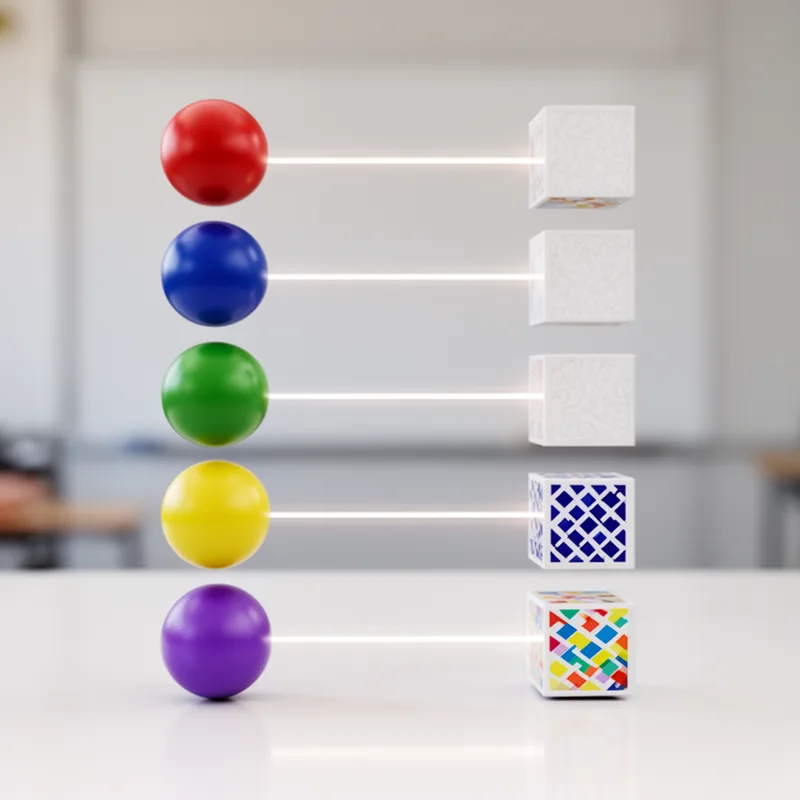
A function is bijective if it pairs each element of one set with exactly one element of another set.
-
So it's F is bijective if it's both injective and surjective.
-
So I'll say bijective, that this is an open set.
-
A vector space V is said to be, whoops, isomorphic with a vector W in case there exists A bijective linear mapping T from V to West.
-
In mathematics, a mapping is bijective when it is both injective and surjective.
Synonyms

 5
4.4
5
4.4

Each thing in one group matches exactly one thing in the other group
Surface Forms
Morphology
bijective = bijection (semi-transparent) = bi + ject + ive
Formed from the technical noun 'bijection' with the productive adjectival suffix '-ive'; the morphological process is regular but the base is a specialized mathematical term, so general learners may not infer the meaning from parts alone.
Etymology
Bijective comes from the parts bi- 'two' and -ject 'to throw', with -ject seen in words like project or reject. Think of a 'two-way throw' that makes perfect pairs between two sets: every item on one side is matched with exactly one on the other, which is why a bijective function is one-to-one and onto.