
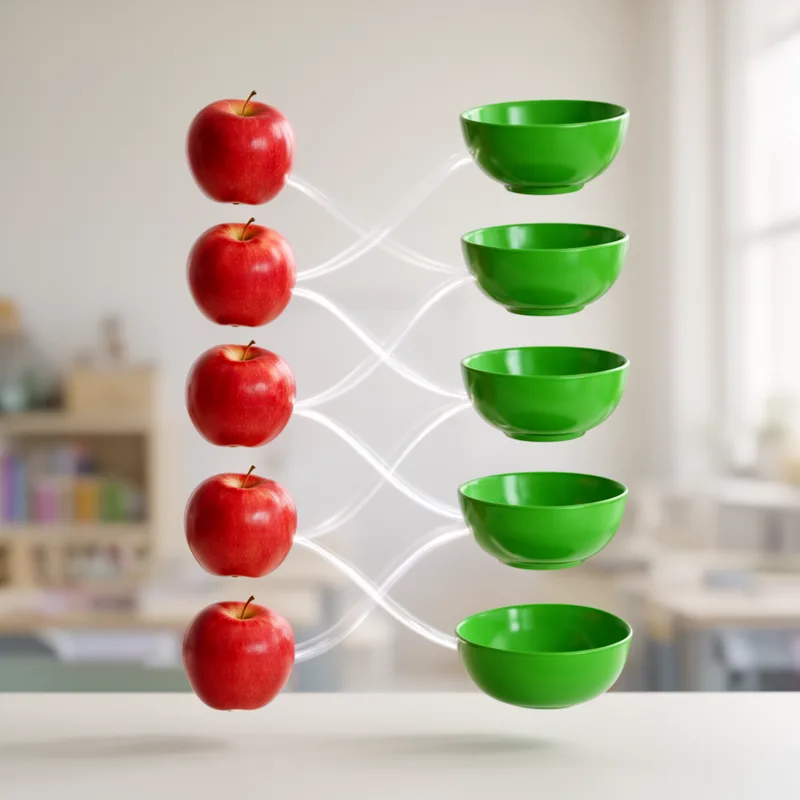
bijection
- noun
- /baɪˈdʒɛkʃən/
- Specialized
- A mapping is considered a bijection if every element from the first set corresponds to one unique element in the second set.
Examples
-
So we have to come up with a bijection between these two sets.
-
So let me define the permutation first or the bijection first.
-
Prove the function F from R to R given by F of X equals Pi X -, e is a bijection and find the inverse.
-
All we're doing really are talking about properties, objections, bijections, surjections, injections.
-
In that case, subtraction can be defined, since for these numbers, things are not reduced modulo bijections.
Blog text (9) -
In mathematics, a bijection pairs each number in set A with exactly one number in set B.
-
To prove that a function is a bijection, you must show that it is both injective and surjective.
Surface Forms
Morphology
bijection = bijective (semi-transparent) = bi + ject + ion
Formally built from the combining form 'bi-' + 'ject' + nominalizing '-ion'; the structure is regular, but 'ject' is not a standalone English word and 'bi-' does not transparently convey the specific mathematical sense to most learners.
Etymology
The word bijection comes from the parts bi- meaning 'two' and -ject meaning 'to throw' or 'send', as in inject and eject. Think of it as 'sending' each item from one group to exactly one partner in the other group, which is why a bijection is a perfect one-to-one pairing between two sets.

