
beta decay


 1
7.7
1
7.7
- noun
- /ˈbeɪtə dɪˈkeɪ/
- Specialized
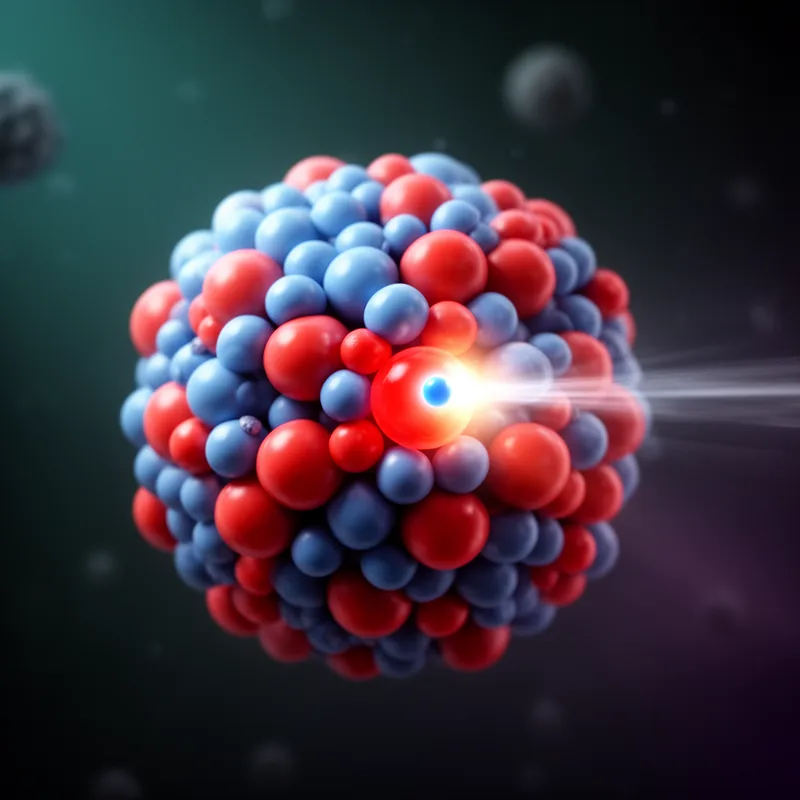
- In beta decay, a neutron in the nucleus transforms into a proton, emitting a beta particle.
- double beta decay
- neutron beta decay
- beta decay experiment
Loading YouTube…
Watch on YouTubeIt'll spontaneously undergo beta decay into a proton and an electron.
- It'll spontaneously undergo beta decay into a proton and an electron.
Examples
-
It'll spontaneously undergo beta decay into a proton and an electron.
-
Now what happens in a beta decay like this?
-
His theory of beta decay alone warranted a prize.
Academic text (2000) -
To determine the right-hand side of equation 3, theorists turned once again to beta-decay data.
Academic text (1995) -
Wolfgang Pauli, in 1930, introduced the idea of a neutrino to account for a certain puzzle in beta decay.
Academic text (1995) -
Enrico Fermi's 1934 theory of beta decay formulated the weak interaction in analogy to the electromagnetic interaction.
Academic text (2004) -
The process of beta decay is crucial for understanding how certain isotopes release energy.
-
During beta decay, the emission of a beta particle results in a change in the atomic number of the nucleus.
Synonyms
 1
6.3
1
6.3
A type of energy made of small fast particles released by radioactive materials
 1
7.5
1
7.5
A kind of radiation made of small fast particles from radioactive atoms

A radioactive material sends out fast electrons during decay
Surface Forms
Morphology
A B1 learner who knows 'beta' as the Greek letter and 'decay' as radioactive disintegration will likely infer that 'beta decay' is a particular type or class of decay named 'beta'. However, the precise mechanism (emission of a beta particle) is technical and not directly derivable from the basic constituent meanings, so the relation is only partially predictable.
Etymology
Beta decay is the name for when an atom's center breaks down and throws out a tiny particle called a 'beta' or 'electron'. The word beta (the small particle) and decay (breaking down) give the image of the atom losing a piece, so the phrase means 'a nucleus emitting a beta particle'.