

bay willow
- noun
- /beɪ ˈwɪloʊ/
- The bay willow is commonly found in wetlands, its glossy leaves creating a vibrant green contrast with the surrounding grasses.
Examples
-
When they drew near, Ayla noticed that it was the smaller variety of cattail that grew so thickly near the edge, along with bay willow brush, some nearly the size of trees.
Fiction book (1990) -
Reed mace, narrow-leaved smaller varieties of cattail, rushes, ferns, and even the bay willow brush that eventually became trees grew along the edges, but extremely tall reed grass, reaching twelve feet in height, was the primary vegetation.
Fiction book (1990) -
In the spring, the bay willow produces soft catkins that attract various pollinators to the area.
-
Many birds build their nests in the dense branches of the bay willow, providing them protection from predators.
Synonyms
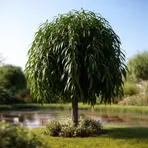
A willow tree from Europe with shiny thick leaves often grown in gardens

A willow tree with shiny, thick leaves often found near water
Surface Forms
Morphology
This is a regular noun–noun compound where 'bay' modifies 'willow', indicating a particular kind of willow. A B1 learner who knows 'bay' (a type of tree) and 'willow' (a Salix tree) can infer it denotes a willow with bay-like characteristics, so the meaning is compositional and predictable.
Etymology
Bay willow may come from the shiny, leathery leaves that look like those of the bay tree, so people used 'bay' to describe this willow that grows in wet places.

