
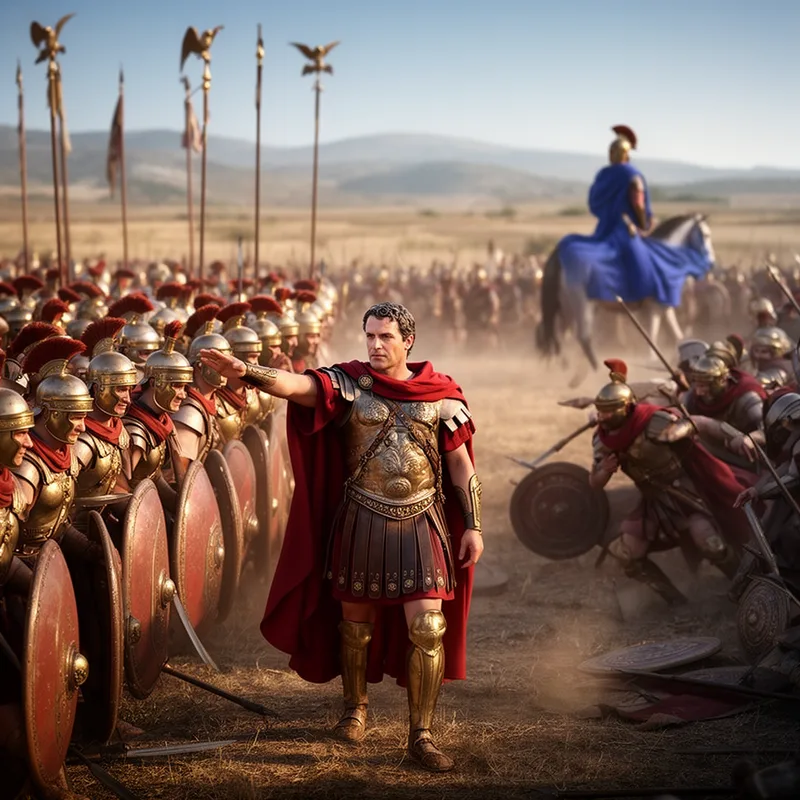
battle of Pharsalus


 1
9.9
- noun
- /ˈbætəl əv fɑrˈsæləs/
- Many historians study the consequences of the battle of Pharsalus for the Roman Republic.
Examples
-
The battle of Pharsalus marked a turning point in Roman history.
-
The battle of Pharsalus was a turning point in Roman history.
-
During the battle of Pharsalus, Caesar's tactical genius secured his victory over Pompey.
-
Did Julius Caesar win the battle of Pharsalus?
-
The battle of Pharsalus marked a turning point in the Roman Civil War, as Julius Caesar emerged victorious over Pompey the Great.
-
In 48 BC, the tactical genius of Julius Caesar was evident during the battle of Pharsalus against Pompey the Great.
-
Historians agree that the battle of Pharsalus significantly influenced the course of Roman history.
Synonyms
 1
9.9
An ancient town in Greece where Julius Caesar defeated Pompey in 48 BC
Surface Forms
Morphology
The phrase is a straightforward composition: 'battle' (a fight) + 'of' + the place name 'Pharsalus' yields 'a battle that took place at Pharsalus.' This location-labelled event construction is cross-linguistically common, so a B1 learner who knows the constituent words would be able to infer it refers to a specific historical battle.
Etymology
The battle of Pharsalus was a famous fight in 48 BC where Julius Caesar, with a smaller and faster army, outsmarted and defeated Pompey the Great on the plain of Pharsalus. That's why the name now refers to that important clash and a 'turning point' in Roman history.