
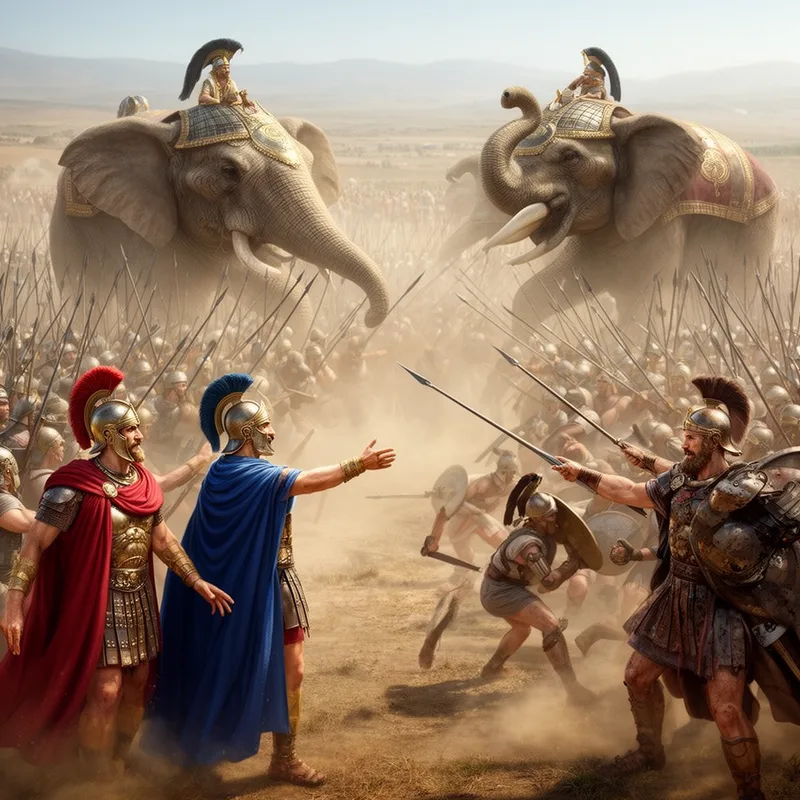
battle of Ipsus


 1
9.9
- noun
- The battle of Ipsus saw the combined forces of Lysimachus and Seleucus emerge victorious.
Examples
-
Historians consider the battle of Ipsus a turning point in the division of Alexander's empire.
-
Many ancient sources recount the strategies used in the battle of Ipsus.
-
The battle of Ipsus was a turning point in history.
-
Many historians study the battle of Ipsus for its significance.
-
Historians consider the battle of Ipsus a turning point in the division of Alexander's empire.
-
The battle of Ipsus saw the combined forces of Lysimachus and Seleucus emerge victorious.
-
Many ancient sources recount the strategies used in the battle of Ipsus.
Surface Forms
Morphology
battle + of + Ipsus
The structure 'battle of + place name' is fully compositional: a learner who knows 'battle' and the place-name 'Ipsus' will understand this denotes a (historical) battle fought at or concerning Ipsus. There is no idiomatic or metaphorical shift in meaning—only historical detail (date, participants) that requires background knowledge—so the expression is transparently derived from its parts.
Etymology
The battle of Ipsus was a big battle in 301 BC near the town of Ipsus where two rival leaders, Lysimachus and Seleucus, joined their armies and used cavalry and war elephants to surround and defeat Antigonus. Because this victory ended one ruler's power, the battle of Ipsus is remembered as a 'turning point' that helped split Alexander's empire.