
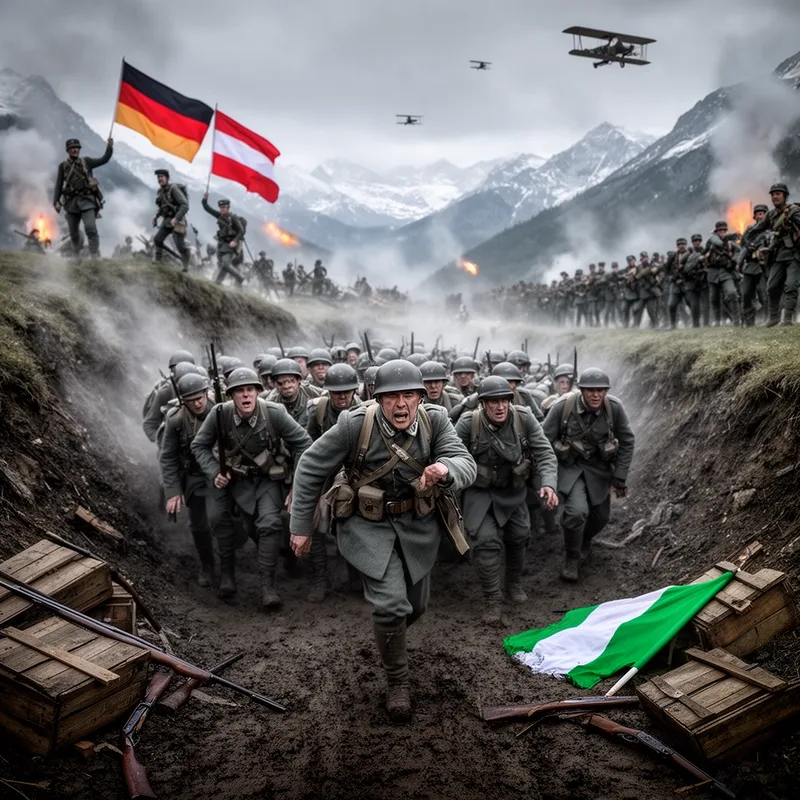
battle of Caporetto


 1
8.4
- noun
- /ˈbætəl əv kəˈpɔːrɛtoʊ/
- In 1917, the battle of Caporetto resulted in heavy losses for Italian forces against Austria and Germany.
Examples
-
The battle of Caporetto marked a significant defeat for the Italian army during World War I.
-
Not until the battle of Caporetto could resistance to the autonomous development of aviation on the part of the top military ranks, at least the most notable ones, be seen to weaken.
Academic text (2010) -
Many historians regard the battle of Caporetto as a turning point in World War I due to its impact on Italian morale.
Synonyms
 1
9.9
A major World War I battle in 1917 where Italy suffered a heavy defeat
Surface Forms
Morphology
The phrase follows the transparent compositional pattern 'battle of + place', so a learner who knows 'battle' and the place-name 'Caporetto' will understand it denotes a battle that took place at Caporetto. While detailed historical facts (date, outcome, participants) are not inferable from the words alone, the basic referential meaning is directly derivable and cross-linguistically common.
Etymology
The battle of Caporetto was a 1917 fight in World War I where the Italian army was surprised and forced to retreat after a big defeat near the town of Caporetto. Because it was such a sudden, huge loss, the name now often stands for 'a complete disaster' or 'a crushing defeat'.