
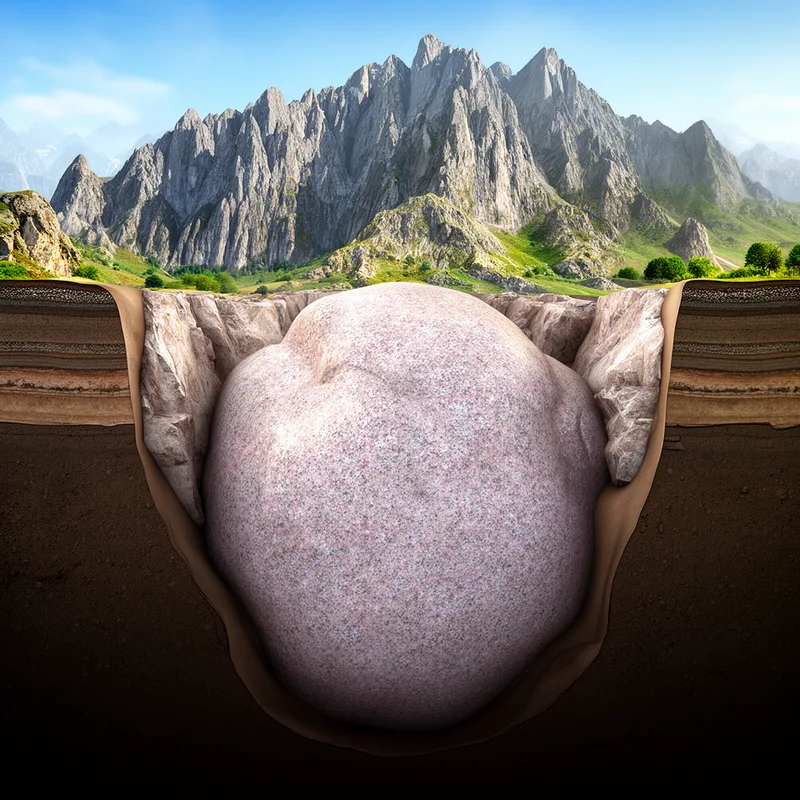
batholith
- noun
- /ˈbæθəˌlɪθ/
- Specialized
- The Sierra Nevada Batholith is famous for its stunning granite peaks, which formed from molten rock that cooled deep underground.
Examples
-
The batholith was discovered during geological surveys.
-
Over millions of years, erosion revealed the batholith buried deep within the earth.
-
Geologists discovered that the mountain range was actually a single massive batholith.
-
The exposed batholith formed the backbone of the region's rugged landscape.
-
Mount Rushmore is carved into a granite batholith.
-
Geologists studied the composition of the Idaho Batholith to understand the processes that created this massive igneous formation.
-
Visitors to Yosemite National Park admire the cliffs of the Sierra Nevada Batholith that were revealed by millions of years of erosion.
Synonyms

 3
8.1
3
8.1

Molten rock pushing into other rock under the ground


 1
9.9
1
9.9
A large mass of hard rock that forms when hot liquid rock deep underground cools slowly

A very large body of hard rock formed deep under the ground

A rock that forms when melted rock deep underground cools slowly
How Big

Surface Forms
Morphology
batholith = batho + lith
Although the word is genuinely built from classical elements meaning roughly 'deep' and 'stone/rock', an average B1 learner is unlikely to infer the geological meaning because these parts are not ordinary English base words.
Etymology
The word batholith comes from the Greek words bathos 'depth' and lithos 'stone', so it literally means 'deep stone'. You can see the same lithos in monolith, which means 'single stone', and this helps you remember the 'stone' part. So a batholith is a very large mass of rock that formed deep under the earth.