
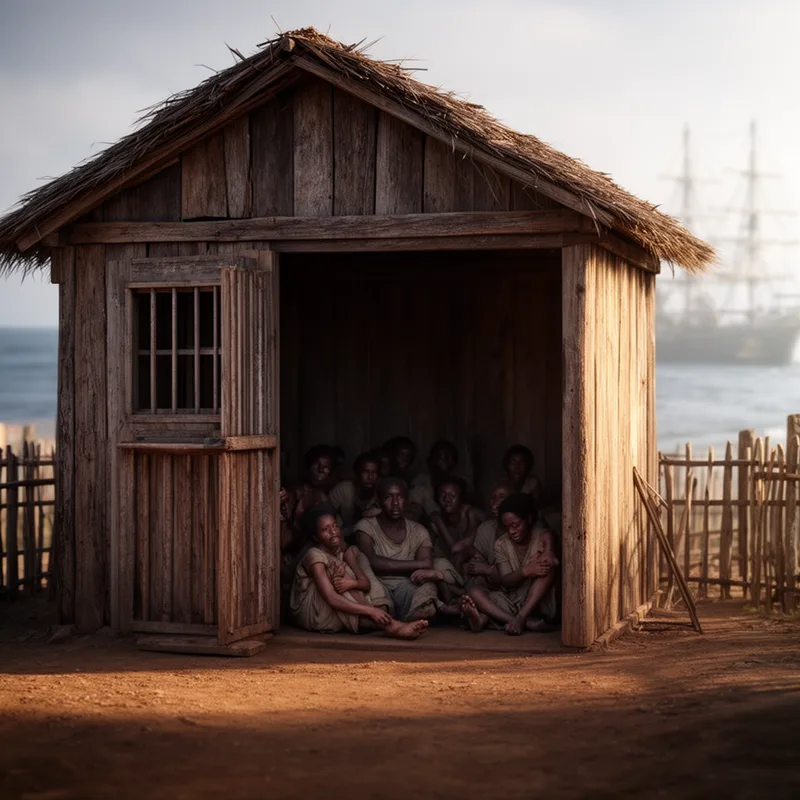
barracoon


 1
9.9
- noun
- /ˌbærəˈkuːn/
- Archaic
- Still, the French traders bought the Africans from barracoons and crammed the captives into the holds of ships as they had always done.
Examples
-
For a report on French barracoons in St. Paul de Loando, see SMN, January 12, 1858, citing an article in the Washington Union.
Academic text (2009) -
Along the side streets, women huddled, knives raised above the heads of their children to save them from slavery among the Wazimba—or the foul-smelling sailors who waited at the barracoons on the coast.
Fiction book (1996) -
Now you have seen the barracoons.
-
And nothing when the coffle reached the barracoon.
Fiction book (1996) -
They were taking us to the barracoons.
-
While awaiting purchase by slave traders, the survivors were held on the coast in hot, crowded buildings called barracoons, where about 12 percent of them died.
Academic text (1991) -
We think immediately of salt loss by sweating under hot conditions: while slaves were working, marching, or confined in unventilated barracoons or ships' holds.
Academic text (1991) -
Reports claimed the French had built their own barracoons near St. Paul de Loando (present-day Luanda) to hold the captured tribesmen.
Academic text (2009) -
Enslaved individuals were often held in barracoons before being transported across the ocean.
-
After arriving at the port, the captives were taken to a barracoon for temporary confinement.
Synonyms
How Harsh

Surface Forms
Etymology
Barracoon comes from the Portuguese and Spanish words barracão and barraca, which mean 'hut' or 'large tent' and are the same root as the English barracks. A barracoon was a simple building used to hold people temporarily, often cruelly used to confine enslaved people before transport.