

banker's bill
- noun
- /ˈbæŋkərz bɪl/
- The museum's exhibit included several banker's bills from different countries.
Examples
-
The banker's bills were printed in various denominations.
-
The collector proudly displayed a rare banker's bill from the early twentieth century.
-
He received payment in the form of a banker's bill rather than coins.
-
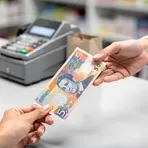
I received a banker's bill as change.
-
He received payment in the form of a banker's bill rather than coins.
-
The collector proudly displayed a rare banker's bill from the early twentieth century.
-
The museum's exhibit included several banker's bills from different countries.
Synonyms
 288
1.5

Money made of paper that people use to pay for things
 104
1.5
A paper bill used as money or a written promise to pay money
 18
5.2
A paper U.S. dollar bill used as money
 18
1.6
Money made of printed paper notes that a government uses
 7
3.0
A paper form of money that people use to pay for things
 6
1.7
Paper money issued by a central bank used to pay for things
 4
2.5
Money in printed notes that people use instead of coins
 3
5.1
Paper money the United States Federal Reserve issues for buying things
 1
3.2
A piece of paper money issued by a central bank used to pay for things
 1
3.2
Paper money that people carry in a wallet


 1
3.7
Paper money issued by a country's central bank used to buy things
How Valuable
 7
3.0
Surface Forms
Morphology
banker's + bill
The phrase is compositionally built from 'banker' (possessive) + 'bill' (paper money), so a learner who knows both words can infer it denotes a bill issued by a banker or bank. The possessive noun + noun pattern and cross-linguistic equivalents (e.g. billete bancario, billet de banque) make the meaning directly derivable for B1 learners.
Etymology
The term banker's bill comes from old banking practice: a banker would write a bill, a 'paper promise to pay the holder', and people used these papers like money. That's why banker's bill now means 'a piece of paper money'.