

bacteriorhodopsin
- noun
- /bækˌtɪəriəʊˈroʊdəpsɪn/
- Specialized
- The bacteriorhodopsin protein helps convert light into energy.
Examples
-
The researchers studied the properties of bacteriorhodopsin to enhance solar energy conversion.
-
Researchers are studying bacteriorhodopsins for potential applications.
-
Scientists use bacteriorhodopsin in experiments to study how cells use light for energy.
-
The purple color of some salt-loving microbes is due to bacteriorhodopsin in their membranes.
-
Researchers engineered bacteria to produce bacteriorhodopsin for use in bioelectronic devices.
-
In the lab, they synthesized bacteriorhodopsin from microorganisms to investigate its light-sensitive attributes.
-
Scientists used bacteriorhodopsin in their experiments on bioengineering to create new light-driven devices.
Synonyms
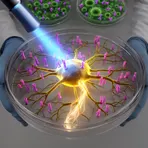
A protein from microbes or made in a lab that makes cells respond to light
Surface Forms
Morphology
Etymology
Bacteriorhodopsin is made of three parts: bacterio 'bacteria', rhodo 'red' or 'rose', and opsin 'vision' or 'seeing'. So it names a red or purple protein in some bacteria that senses light and helps the cells use light.

