
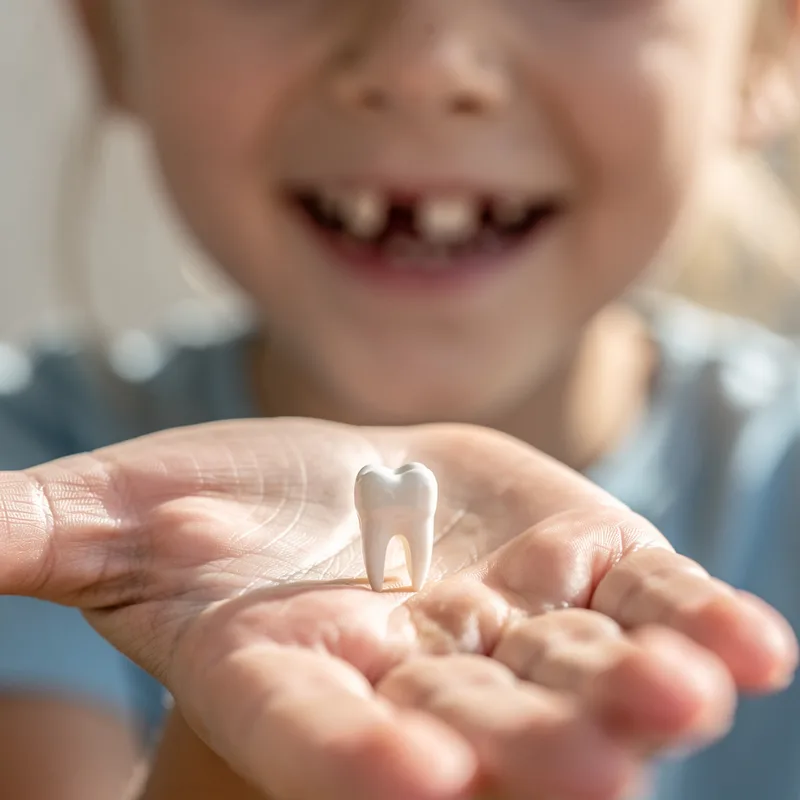
baby tooth
 14
1.2
14
1.2

- noun
- /ˈbeɪbi tuθ/
- When a child loses a baby tooth, a permanent one will eventually grow in its place.
- losing baby teeth
- first baby tooth
- missing a baby tooth
Loading YouTube…
Watch on YouTubeAnd we can tell this by the stable isotope analysis of their baby teeth, which we have found.
- And we can tell this by the stable isotope analysis of their baby teeth, which we have found.
- But that that larger Tusk picture is also rough by comparison to the young baby tooth.
Examples
-
The dental appointment was for a non-emergency; my daughter's baby tooth, loose for a couple of months, was still not coming out.
Blog text (32) -
Very often, if well taken care of, someone can keep their baby tooth long into adulthood and sometimes for life.
Blog text (14) -
But they were baby teeth, so they grew back.
-
Yes, but my baby teeth are gonna fall out, anyway.
-
Um, I think soft might be more for baby teeth.
-
I hope those were baby teeth.
-
And you still got your baby teeth
-
Often, if it's one or two teeth, a patient can maintain the baby tooth for as long as possible.
Blog text (14) -
Luckily, my mom saved this old baby tooth.
-
I'm really small for my age and I'm losing my baby teeth much later than everyone else at my age.
Synonyms

 1
3.1
1
3.1
A child's first tooth that falls out when an adult one grows
 1
3.3
1
3.3
A child's baby tooth that falls out and is replaced by an adult tooth
 1
3.4
1
3.4
One of a child's first teeth that falls out and is replaced by an adult tooth
Antonyms

Surface Forms
Morphology
The meaning 'a temporary tooth in young children' is directly derivable from combining 'baby' (a very young child) with 'tooth' (a biting/chewing tooth): it simply denotes a tooth belonging to a baby/young child. This noun–noun composition is regular and cross‑linguistically common, so a B1 learner who knows both constituents will readily infer the intended meaning.
Etymology
Baby tooth comes from the simple image of a small tooth that belongs to a baby or young child. Because these first teeth fall out and are later replaced, the phrase means 'a temporary tooth'.