
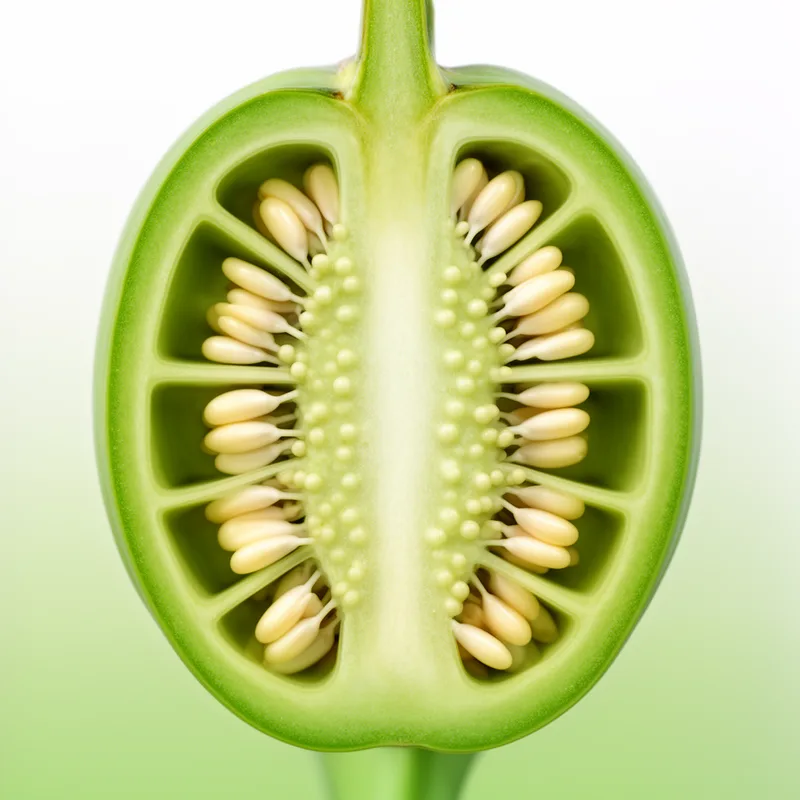
axile placentation
- noun
- /ˈæksaɪl pleɪsənˈteɪʃən/
- Specialized
- In lilies, axile placentation is found, where ovules develop along a central axis.
Examples
-
The fruit of the tomato plant also displays axile placentation in its ovary structure.
-
Botany students often compare axile placentation with parietal placentation to understand floral anatomy.
-
The flower exhibits axile placentation in its reproductive structure.
-
Many plants with axile placentation have a unique fruit structure.
-
In lilies, axile placentation occurs, allowing ovules to develop along the central axis of the ovary.
-
The fruit of the tomato plant showcases axile placentation, where ovules are attached around the center of the ovary.
-
Botany students study axile placentation to better understand how ovules are positioned in certain flowering plants.
Surface Forms
Morphology
The term is directly compositional: 'axile' means attached to or occurring around an axis and 'placentation' denotes the pattern/placement of ovules, so the phrase literally describes ovules attached around the central axis of a compound ovary. Although technical vocabulary, the overall meaning follows straightforwardly from the constituent parts and would be understandable to a learner who knows both component terms.
Etymology
Axile placentation describes a flower or fruit where the seeds, called 'ovules', are attached around a central axis inside the ovary, like sections on a middle column. So the name, with axile meaning 'axis' and placentation meaning how seeds are placed, shows the seeds are 'placed on the axis', which is the sense used today.

