
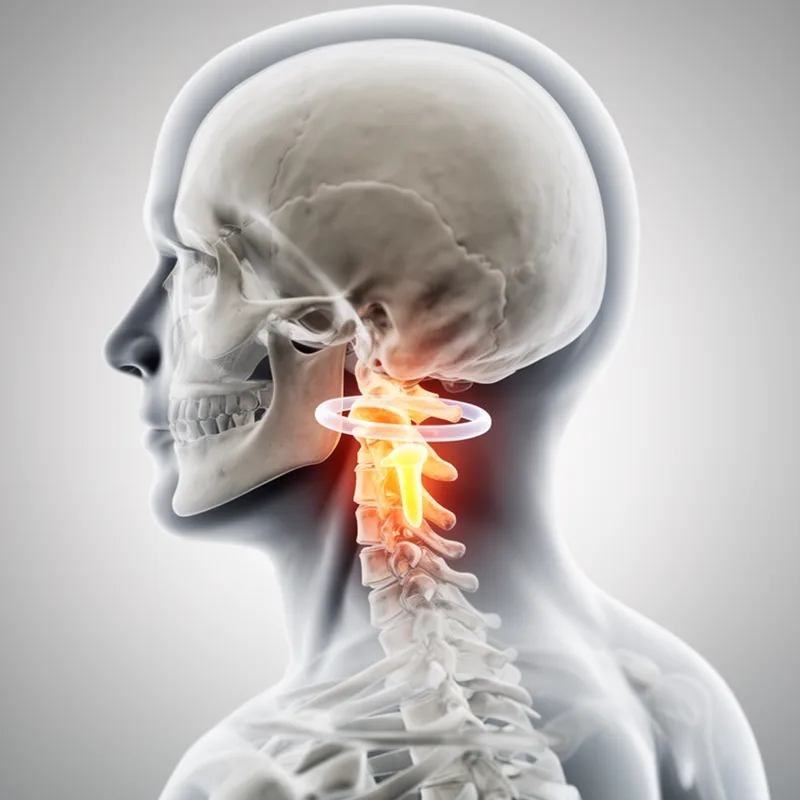
atlantoaxial


 1
9.9
Relates to the joint between the first and second bones in the neck that lets the head turn
- adjective
- /ˌæt.læn.toʊˈæk.si.əl/
- Specialized
:
atlantoaxial
- Doctors often monitor patients for atlantoaxial instability, especially in individuals with certain genetic disorders.
- atlantoaxial subluxation
Examples
-
For example, children with Down syndrome are susceptible to atlantoaxial instability (AAI), which can cause paralysis if the child hyperflexes his/her neck.
Academic text (1996) -
Possible Spinal Presentation of DISH Atlantoaxial Subluxation
Academic text (2004) -
The atlantoaxial joint allows for the rotation of the head while keeping the spine stable.
-
In severe cases, atlantoaxial subluxation may require surgical intervention to prevent spinal cord damage.
Surface Forms
atlantoaxial positive
Morphology
Etymology
Atlantoaxial comes from the names of two neck bones: atlanto- from atlas, the top bone that 'carries' the head, and axial from axis, the second bone whose name means 'pivot' or 'axle'. So, atlantoaxial describes the joint where the 'carrier' and the 'pivot' meet to let the head turn.