

astronomy unit
- noun
- /əˈstrɒnəmi ˈjuːnɪt/
- Specialized
- Astronomers use astronomy units to keep track of vast distances in space, simplifying measurements for their research.
Examples
-
The distance from the Earth to Mars can vary, but it is often measured in astronomy units for clarity.
-
After she completes the astronomy unit of her Earth-science course, Heather is interviewed again.
Academic text (1994) -
Scientists estimate that the nearest star is about four astronomy units away from our solar system.
Synonyms

 1
6.5
1
6.5

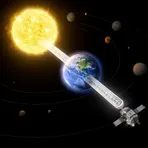
The average distance between the Earth and the Sun, about 150 million kilometers
 1
7.4
1
7.4
A unit of distance equal to the average space between Earth and the Sun, about 150 million kilometres
Surface Forms
Morphology
The compound is compositionally interpretable: a B1 learner who knows 'astronomy' and 'unit' can infer it denotes a unit used in astronomy. However, the precise technical meaning (the mean Earth–Sun distance) and the usual collocation 'astronomical unit' are specialized knowledge and not predictable from the constituents alone, so learners would get the general idea but not the exact definition.
Etymology
The term astronomy unit comes from choosing the average distance from the Earth to the Sun as a basic measure, so the words astronomy and unit point to a space measure. Think of it as one long 'Earth-to-Sun' step. That's why scientists use it as a 'unit of length' to talk about distances in space.