
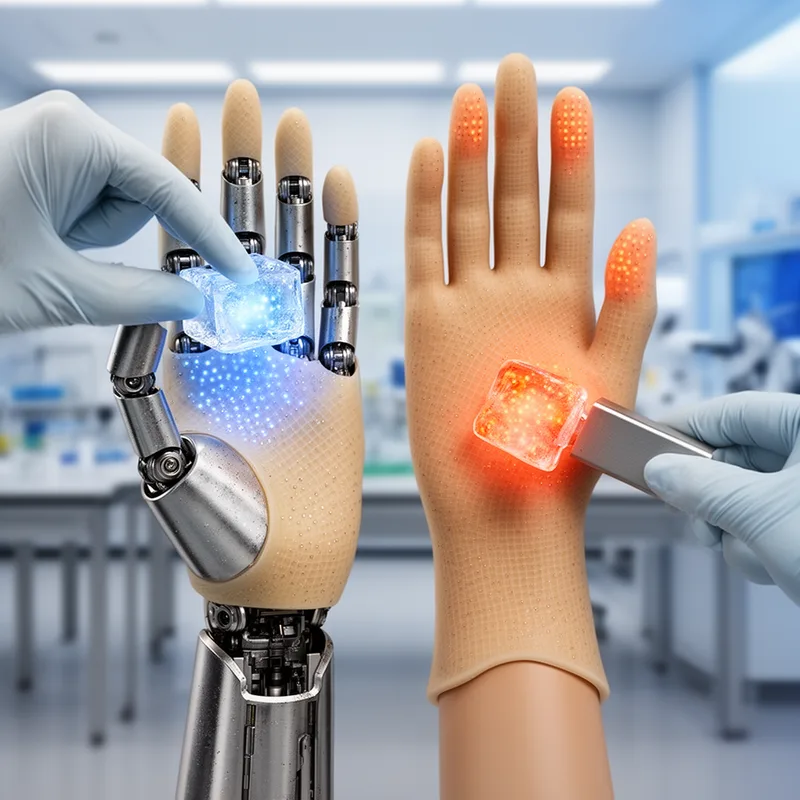
artificial skin
- noun
- /ˌɑːrtɪˈfɪʃəl skɪn/
- Specialized
- The robot's artificial skin can sense temperature changes.
Examples
-
Engineers tested different artificial skins printed with tiny sensors for more natural feedback.
-
Researchers integrated artificial skin into the robot hand to sense touch and temperature.
-
The prosthetist covered the new limb with flexible artificial skin that responded to pressure.
-
Many researchers are developing artificial skin for prosthetics.
-
Researchers are developing artificial skin that can detect touch and temperature for robotic applications.
-
The prosthetic limb was fitted with advanced artificial skin to enhance its sensitivity to pressure.
-
Engineers are testing artificial skin to improve the realism of robotic hands, making them more responsive to interactions.
Antonyms


How Sensitive
- Specialized

Surface Forms
Morphology
The compound 'artificial skin' is directly and predictably interpreted as a man-made imitation of bodily skin by combining 'artificial' (man-made/imitation) + 'skin' (body covering); a B1 learner who knows both words can infer it's a synthetic skin-like material. Specific technical details (e.g. sensors, use on robots or prosthetics) are pragmatic extensions of that basic meaning but do not undermine the clear compositional relation, which is common across languages.
Etymology
Artificial skin for robots and prosthetics is a thin, flexible cover that lets machines 'feel'. The parts artificial ('made by people') and skin ('the body's outer layer') connect to the image of tiny sensors like 'nerves' under a soft surface, so it means a skin-like layer that senses touch and temperature.