
arcsecant
- noun
- /ˌɑrkˈsiːkənt/
- Specialized
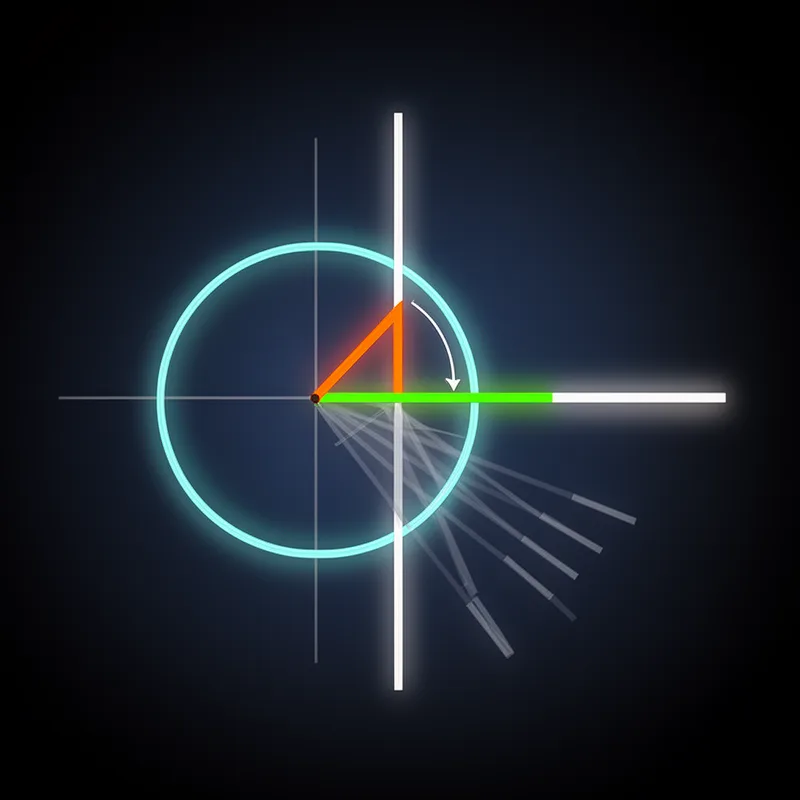
- The arcsecant of 2 is the angle whose secant is 2.
Examples
-
Some calculators do not have a direct arcsecant button, so alternate methods are required.
-
To find the angle whose secant is 2, you must calculate the arcsecant of 2.
-
In this equation, you need to use the arcsecant function to find the value of x.
-
The arcsecant is a crucial concept.
-
What is the arcsecant of 1?
-
In trigonometry, the arcsecant function helps determine angles based on the secant value.
-
When solving for x, the arcsecant of the number provided gives the required angle.
Synonyms

An angle whose secant or 1 divided by its cosine equals a given number

An angle that has a given secant value

An angle whose cosine equals 1 divided by a given number
Surface Forms
Morphology
Etymology
Arcsecant comes from two parts: arc and secant. arc means a curved 'part of a circle' (think of the 'arc' of a rainbow), and secant comes from a root that means 'to cut', like in the word section, because a secant is a line that 'cuts' a circle. So, arcsecant names the angle (an arc) that has a given secant value, in other words the angle whose secant is that number.

