
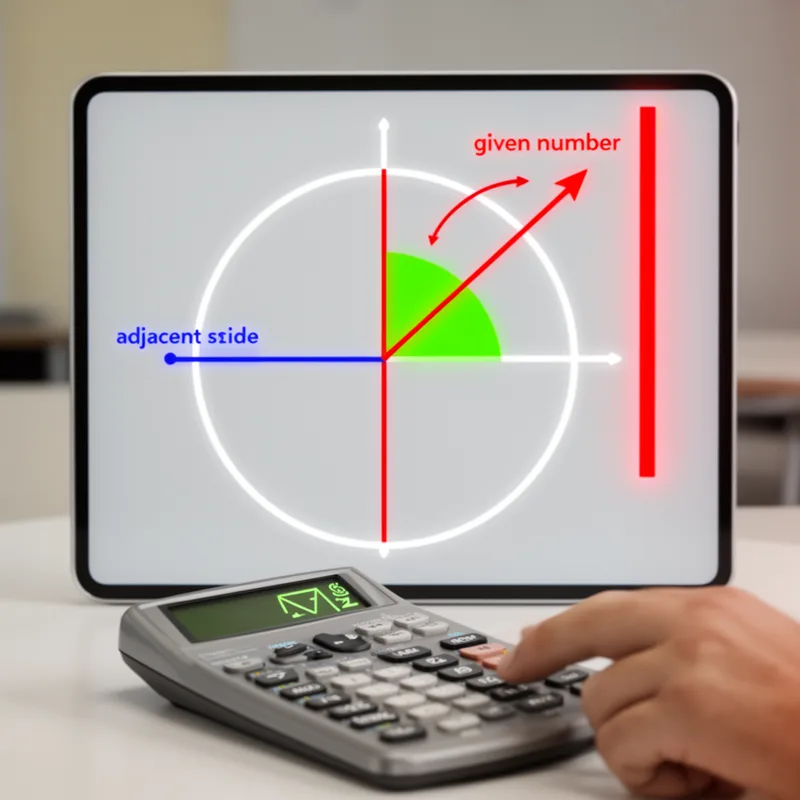
arc secant
- noun
- /ɑrk ˈsiːkənt/
- Specialized
- To find the angle in a right triangle, we can use arc secant to determine the angle whose secant is the given length.
Examples
-
So to get Theta, we'll take arc secant or the inverse secant function of both sides.
-
The arc secant function helps calculate the angle when the secant value is known, which is essential in trigonometry.
-
In advanced mathematics, one often employs arc secant to reverse the secant function and find the corresponding angle.
Synonyms

An angle whose cosine equals 1 divided by a given number

The angle whose secant is a given number
An angle that has a given secant value
Surface Forms
Morphology
Although the parts 'arc' (a curve) and 'secant' (a trigonometric function) are semantically clear, the meaning 'the inverse function of the secant' relies on a specialized mathematical naming convention (arc + trig function = inverse) rather than ordinary compositional semantics. A B1 learner who knows the constituent words but lacks this technical convention would not be able to derive the inverse-function sense, so the expression is not transparently predictable.
Etymology
Arc secant comes from two words: arc, a part of a circle, and secant, a Latin word meaning 'cut' used for a line that cuts a circle. In math 'secant' became the name of a function, and arc secant means 'find the arc' or 'angle' whose secant is a given number.

