

apogee
 2
9.4
2
9.4

- noun
- /ˈæpəˌdʒi/
- Specialized
- Astronomers noted that the Moon's apogee occurs approximately every 27.5 days during its orbit.
- the moon is at apogee
Examples
-
The spacecraft is now in elliptical orbit... with an apogee of 141 nautical miles and a perigee of 122 nautical miles.
-
The average full moon is the one falling midway in distance between perigee, the closest point to Earth along the moon's orbit, and apogee, the farthest point.
Academic text (2004) -
When we reach apogee, we'll be only about a hundred twenty million miles from Mr. Torrid, and you can add thirty to that.
Fiction book (1999) -
The Moon is at apogee, 4:38 A.M. PST.
Academic text (2007) -
Tensely, they stared at the moon, now at its apogee.
Fiction book (1990) -
The moon is at apogee (farthest from the Earth) at noon.
Academic text (1990) -
" Westar had been left in a lopsided orbit, with an apogee of about 650 miles and a perigee of just 160 miles.
Blog text (11) -
The Moon passes 1.6 degrees north of Saturn at 5 p.m. PST. The Moon is at apogee at 3:20 p.m. PST. The Leonid meteor shower peaks on the 19th.
Academic text (2006) -
The satellite reached its apogee and was farthest from the Earth at that moment.
-
On its journey, the spacecraft calculated the apogee to be 400 kilometers above the Earth's surface.
Synonyms
 11
3.7
11
3.7
The top level that something reaches
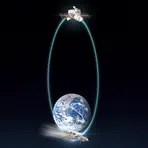
The point in an orbit that is farthest from the planet or star it goes around

The point in an orbit when an object is farthest from the planet or star it goes around
Antonyms

Compounds

- Specialized
The path a satellite follows at the highest point in its orbit around a planet
How Near
- Specialized
4
9.9

- Specialized
2
9.4
Surface Forms
Etymology
Apogee comes from Greek parts apo- meaning 'away' and ge- meaning 'earth', the same 'ge-' you see in geography, so it literally means 'away from the Earth' and names the point in an orbit when a satellite is farthest from the planet.