
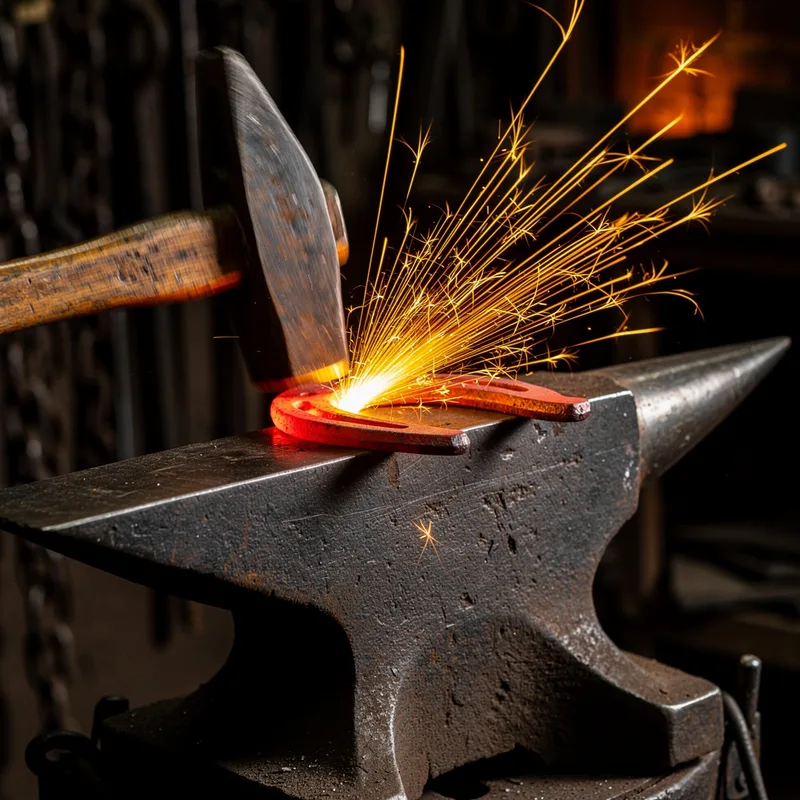
anvil
 16
5.6
16
5.6

- noun
- /ˈæn.vɪl/
- To create the perfect blade, he began by heating the steel and then pounding it on the anvil.
- hammer and anvil
- stone anvil
Loading YouTube…
Watch on YouTubeA roadside inn in autumn and anvil clanging.
- A roadside inn in autumn and anvil clanging.
- And then, you know, you know, a big hammer or an anvil or something would fall down and kill the deer.
- Vladimir Ilitch said that the only question in politics was who, whom, hammer or anvil.
- It just came, made my table, brought this anvil, some pure Suns, a Danish, and it's toasty warm.
Examples
-
I carried the anvil to the cart we used to transport goods to and from the beach.
Fiction book (1991) -
Next, he placed the iron on the anvil and beat it into a horseshoe.
Fiction book (2000) -
From far off, the blacksmith can be heard evenly striking his anvil: he's working late.
Fiction book (1995) -
The shop was full of precisely arranged hammers, tongs, tweezers, anvils, and other equipment.
Fiction book (1994) -
The blacksmith skillfully shaped the glowing metal on the anvil before it cooled.
-
After setting up the workshop, she placed the anvil at the center for easy access while forging.
Idioms

To have to choose between two equally bad options while people on both sides pressure you



Compounds

How Heavy

Surface Forms
Etymology
Anvil comes from an old English word for the heavy metal block used by blacksmiths, and a helpful way to remember it is to think of the smith's strong 'work block' for shaping hot metal. That's why an anvil is a flat, hard surface you strike with a hammer.