

anurous
- adjective
- /ˈænərəs/
- Specialized
- In their life cycle, most frogs become anurous, losing their tails after the tadpole stage.
Examples
-
Some ancient amphibians retained tails, but modern toads and frogs are typically anurous.
-
The scientists studied both tailed and anurous amphibians in their research.
-
Many species of frogs are anurous as adults, lacking tails entirely.
-
The anurous frog jumped gracefully into the pond.
-
Many anurous species thrive in wet environments.
-
Many species of frogs are anurous as adults, lacking tails entirely.
-
Some modern amphibians, like toads, are commonly anurous and do not have tails.
Synonyms

 1
3.9
1
3.9

An animal or object without a tail

Having no tail or tail-like part

Not having a tail or tail-like part
Antonyms
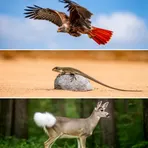
Surface Forms
Morphology
anurous = Anura (opaque) = anura + ous
The adjective is formed from the technical taxonomic stem 'Anura' + '-ous', a formation that relies on scientific/Greek combining forms unfamiliar to average learners, so the meaning is not directly derivable.
Etymology
Anurous comes from the Greek parts a- 'without' and oura 'tail', so it means 'without a tail'. That's why anurous animals, like many adult frogs, do not have tails.