

antirealism
- noun
- /ˌæntiˈriːəlɪzəm/
- Formal
- Discussions about scientific realism or antirealism usually talk about theories, explanations, and predictions.
- radical antirealism
Examples
-
Philosophers often discuss antirealism, emphasizing that our perceptions shape what we consider real.
-
It takes a grasp of the philosophical issue of reality to evaluate the claims of radical antirealism.
Academic text (1995) -
Same for the realism-antirealism debate in the philosophy of science.
Blog text (25) -
I want to call the view that "information" is an ideological construct information antirealism.
Blog text (15) -
Insofar as one begins with the equipment provided by language and accepts the inevitability of an equation between language and knowledge, one's likely stance is antirealism.
Academic text (1991) -
Thus, while postmodernist discourse often includes formulations that signal cultural relativism or even a radical antirealism, critical approaches to literary postmodernism are, in fact, much less extreme in their practices.
Academic text (1995) -
For Churchland, the arbitrariness and conventionalism of what we think of as natural, our "conceptual inertia," as he calls it (a condition from which he clearly does not suffer), does not become evidence for antirealism; it does not suggest the unreality of the material world.
Academic text (1991) -
An argument for information antirealism comes from Geoffrey Nunberg's "Farewell to the Information Age," which notes that the modern usage of "information" is historically recent and asserts that this usage is the result of a confusion (either intentional or otherwise) of other meanings.
Blog text (15) -
The debate between realism and antirealism challenges our understanding of knowledge and existence.
-
Critics of scientific theories sometimes adopt antirealism, questioning whether reality exists independently of observation.
Synonyms

 4
8.7
4
8.7

Reality exists because of the mind and ideas, not independent physical things
 2
9.9
2
9.9
The idea that mind or awareness is the most real thing and objects are only parts of it
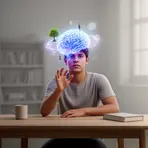
A belief that only minds and ideas are real, not physical things

The view that only things we sense exist and objects do not exist on their own

The idea that the outside world is not really there and only seems real
Antonyms

How Real
- Specialized

- Specialized
2
8.1
- Specialized

 1
9.9
1
9.9
- Formal
Surface Forms
Morphology
Etymology
Antirealism comes from anti- 'against' and realism, the idea that things exist 'on their own' without our minds. So in philosophy, antirealism is the view 'against' that idea: it says some parts of reality or truth do not exist on their own but depend on our minds or how we observe them.