
antilepton
- noun
- /ˌæntiˈlɛptɒn/
- Specialized
- The positron is an example of an antilepton, being the antiparticle of the electron.
Examples
-
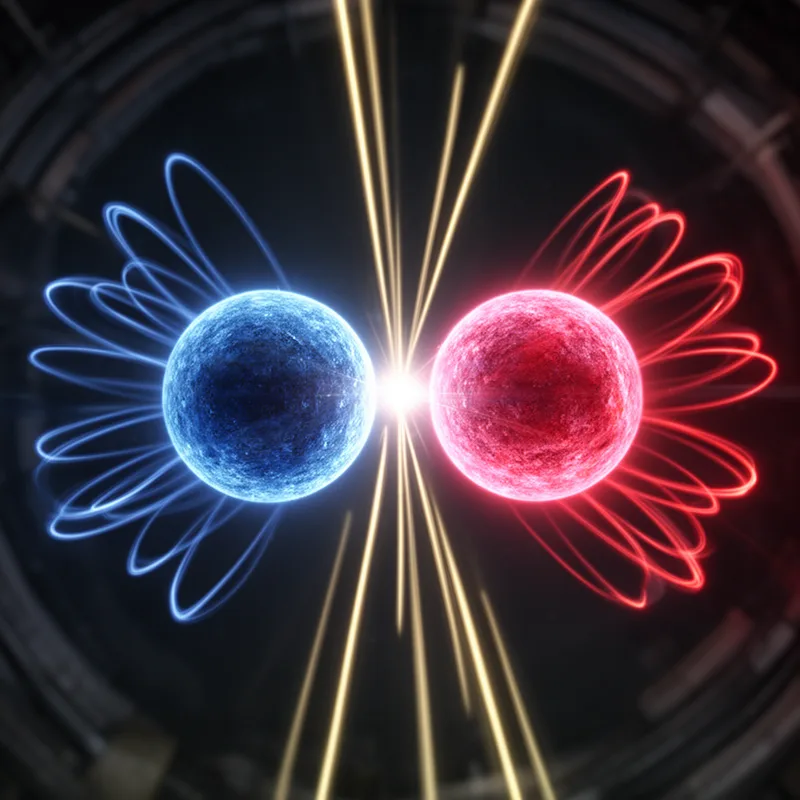
When a lepton collides with its matching antilepton, they can annihilate each other, producing photons.
-
An antilepton has the opposite charge of a lepton.
-
In high-energy physics experiments, the creation of an antilepton can be observed alongside its corresponding lepton.
-
The physicist explained the role of antileptons in particle physics.
-
In high-energy physics experiments, the creation of an antilepton can be observed alongside its corresponding lepton.
-
The positron is an example of an antilepton, being the antiparticle of the electron.
-
When a lepton collides with its matching antilepton, they can annihilate each other, producing photons.
Synonyms
 1
9.3

A particle with the same mass but opposite charge that destroys its partner and releases energy when they meet
Antonyms
- Specialized
2
9.9
A tiny particle like an electron that does not take part in the strong force
Surface Forms
Morphology
Etymology
Antilepton breaks into anti- meaning 'opposite' and lepton from a Greek word meaning 'small'. So an antilepton is the particle that matches a lepton but has the opposite electric charge.