
antiferromagnetism


 1
9.9
- noun
- /ˌæntɪˌfɛrəmæɡˈnɛtɪzəm/
- Specialized
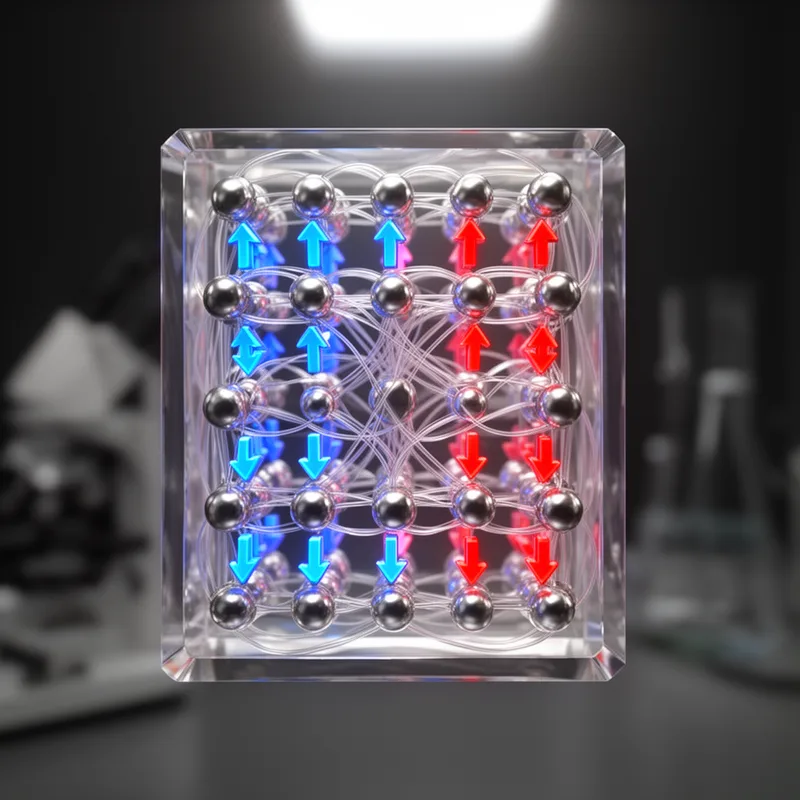
- Many materials exhibit antiferromagnetism, where the magnetic moments are aligned in opposite directions.
Examples
-
In the course of this work, they came up with the first experimental demonstration of the existence of antiferromagnetism, which had been predicted by Louis Neel.
Academic text (1994) -
Awschalom says this transition provides direct evidence of antiferromagnetism in ferritin, a state that had only been inferred previously.
Academic text (1994) -
Shull's group interpreted the latter state as antiferromagnetism.
Academic text (1994) -
He received his 1970 Physics Nobel Prize for the discovery of antiferromagnetism, ferrimagnetism, and the Nel temperature at which the former magnetic behavior stops.
Blog text (9) -
The research paper discussed the concept of antiferromagnetism and its impact on material science.
-
The properties of antiferromagnetism help scientists understand how particles interact within certain materials.
Surface Forms
Morphology
antiferromagnetism = ferromagnetism (opaque) = anti + ferro + magnet + ism
The form is built from recognisable scientific morphemes, but the term is too specialized for an average B1 learner to infer the meaning confidently.
Etymology
Antiferromagnetism breaks into anti- 'against', ferro- 'iron', and magnetism 'magnetic force'. So it describes a type of magnetism where tiny magnetic arrows inside a material point in opposite directions and cancel each other, leaving no overall magnet.