
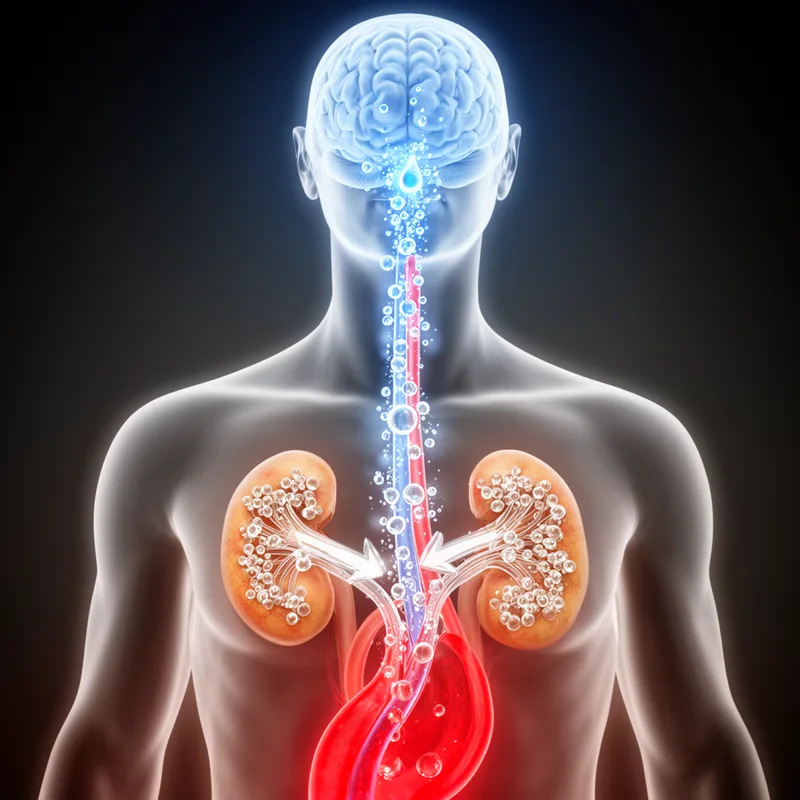
antidiuretic hormone
- noun
- /ˌæntiˌdaɪjʊˈrɛtɪk ˈhɔrmoʊn/
- Specialized
 :
hormona antidiurética
:
hormona antidiurética
- In healthy individuals, antidiuretic hormone assists in maintaining proper blood pressure by controlling fluid levels.
- antidiuretic hormone (ADH)
Examples
-
Secretion of inappropriate antidiuretic hormone (SIADH) often goes unidentified.
Academic text (2005) -
Eighty percent of patients with severe infection had hyponatremia, which suggests a syndrome involving inappropriate antidiuretic hormone (29).
Academic text (2012) -
Urine production is reduced by about 50% at night in response to the circadian rhythm of the antidiuretic hormone (ADH).
Academic text (2012) -
This study was undertaken to evaluate osmolality and arginine vasopressin (AVP) or antidiuretic hormone (ADH) levels during the course of major head and neck surgery.
Academic text (1998) -
The antidiuretic hormone regulates water balance in the body by promoting water reabsorption in the kidneys.
-
A deficiency of antidiuretic hormone can lead to excessive urine output and dehydration.
Synonyms

 1
9.3
1
9.3

A hormone that raises blood pressure and makes the kidneys save water

A medicine that raises blood pressure and reduces urine output

A hormone made in the brain that tells the kidneys to keep water and make less urine
Surface Forms
Morphology
The phrase is directly compositional: 'antidiuretic' (reduces urine production) modifies 'hormone' (a glandular chemical), so it denotes a hormone that reduces urine output and promotes water reabsorption. This transparent modifier+noun pattern is regular and predictable, so a B1 learner who knows both constituents would understand the MWE.
Etymology
Antidiuretic hormone breaks into anti ('against') and diuretic ('makes you pee'). It is a hormone that tells the kidneys to keep water, so you make less urine and your blood pressure can stay steady.