
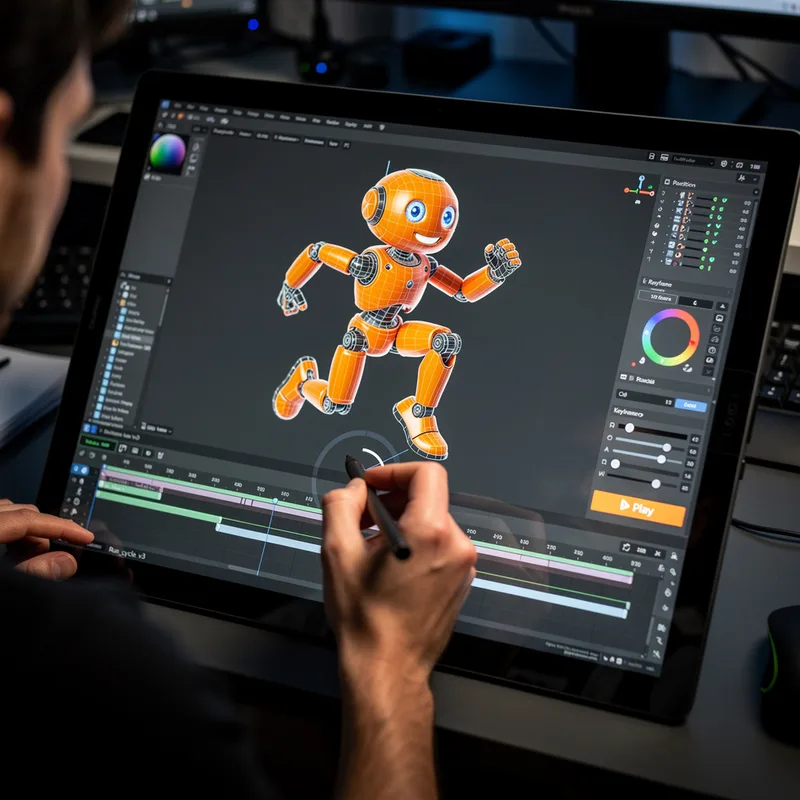
to animate
 24
4.2
24
4.2

- verb
- /ˈænɪˌmeɪt/
- To bring the story to life, the filmmakers wanted to animate the scenes with vibrant colors and smooth transitions.
- animated film
- animate characters
- animated image
Loading YouTube…
Watch on YouTubeHe's saying so-called here primitive mind to animate its environment.
- He's saying so-called here primitive mind to animate its environment.
Examples
-
I'm animating with salt, but I've only shot like 10 frames of it so far.
-
They used to interview people just on the street, and then they would animate the characters with random people's voices.
-
And I can now animate that by going to transform and position.
-
Through the use of this app, students are able to animate, score, and share cartoon stories of their own creation.
Academic text (2015) -
When you animate something, save it somewhere where you're going to remember where it is.
-
Designed for your iPhone or iPad, a child can animate the tale simply by touching the screen.
Academic text (2014) -
Readers will be begging for the next episode in this high-quality animated storybook series.
Academic text (2015) -
The temporal vortex was a computer-generated effect animated by ILM's Habib Zargarpour.
-
In the animation class, we learned how to animate characters to make them appear lifelike.
-
The artist decided to animate her drawings, giving each character its own unique movements.
Synonyms
To make something seem alive or able to move
How Lifelike
64
3.7
 24
4.2
24
4.2
Surface Forms
Morphology
animate = anim + ate
The root 'anim-' is a Latin combining form (not a standalone English word), so the composition anim + -ate is not transparently recoverable by a typical B1 learner.
Etymology
Animate as a verb comes from Latin animare 'to give life', and you can see the same idea in animation. So to animate a picture, puppet, or character is to make it seem alive or move like a living thing.