
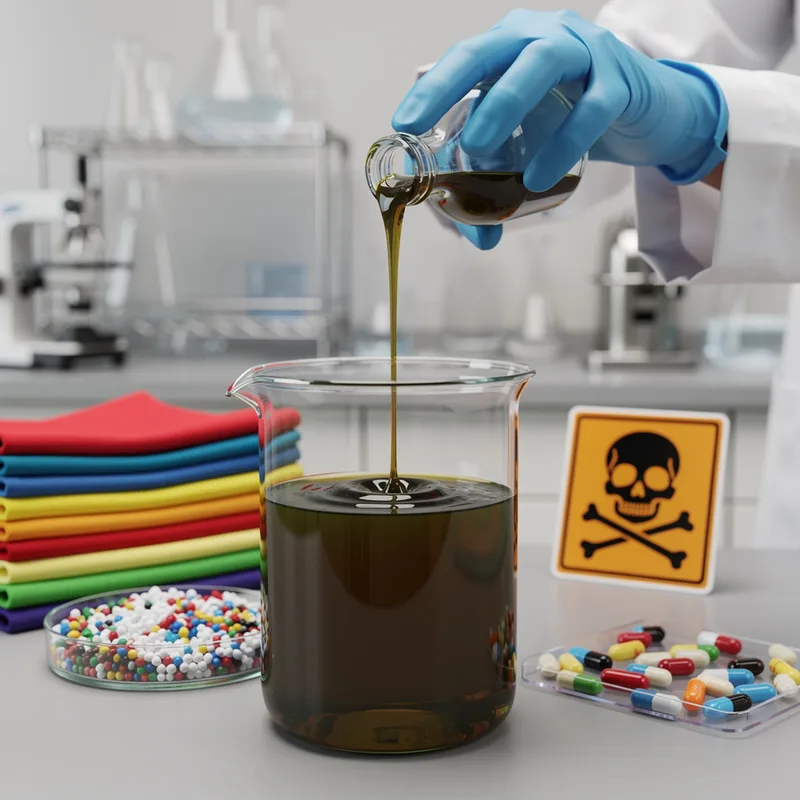
aniline
 1
9.6
1
9.6

- noun
- /ˈænəˌlin/
- Specialized
- Water-based aniline paints gave way to house paints that did not run as much and were less likely to fade in the sun.
- aniline paints
Examples
-
The laboratory technician carefully measured a quantity of aniline to prepare the dye solution.
-
Nowadays, aniline is only used by Isidoro Cruz of San Martin and some carvers from the extended Santiago family of La Union.
Academic text (2000) -
I am now going to add some aniline and potassium hydroxide.
Fiction book (1994) -
Aniline dyes and colored inks are transparent to infrared.
-
In the late 1980s, carvers could be divided into those who used aniline and those who were switching to vinyl-acrylic house paints.
Academic text (2000) -
Most contemporary artisans in La Union specialize in modified versions of these simpler carvings, sometimes painted with aniline.
Academic text (2000) -
A visitor to his laboratory "was confronted with a symphony of colors... thousands upon thousands of glass bottles stood around, all filled with the brightest aniline dyes."
Academic text (2010) -
Elodia once used aniline paints, but switched to house paints around 1985 at the request of Henry Wangeman, a dealer who bought many of the family's pieces at that time.
Academic text (2000) -
In the production process, aniline is often combined with other chemicals to create vibrant colors for textiles.
-
When manufacturing plastics, the use of aniline is critical due to its unique chemical properties.
Synonyms

 1
9.9
1
9.9
An oily poisonous liquid used to make dyes, plastics, and medicines

A poisonous oily liquid used to make dyes, plastics, and medicines
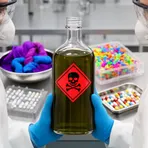
A poisonous oily liquid used to make dyes, plastics, and medicines
Compounds

Surface Forms
Morphology
Etymology
The word aniline comes from the old word anil, which means 'indigo' or 'blue' in languages like Arabic and Spanish, and the chemical ending -ine was added. It was first made from the indigo dye, so the name reminds us that aniline is a chemical linked to dye making and other industrial uses.