
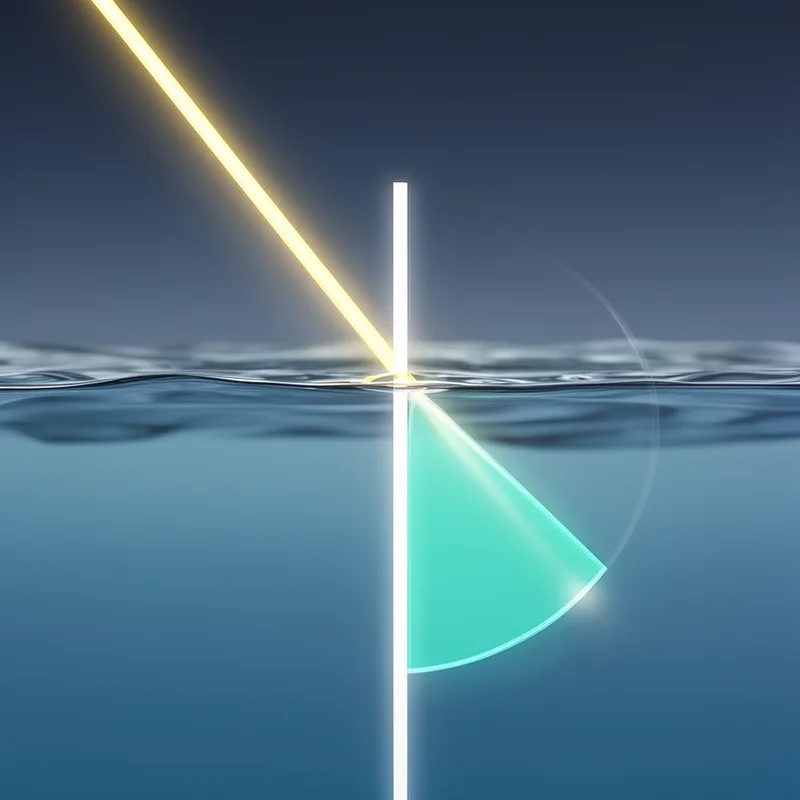
angle of refraction
- noun
- /ˈæŋɡəl əv rɪˈfrækʃən/
- Specialized
- When light passes from glass to air, the angle of refraction is greater than the angle of incidence.
Examples
-
Snell's law can be used to calculate the angle of refraction when light enters water from air.
-
The angle of refraction depends on the speed of light in the two media involved.
-
The angle of refraction changes as light passes through different materials.
-
Can you calculate the angle of refraction for this prism?
-
Using Snell's law, we can find the angle of refraction as light travels from air into water.
-
The angle of refraction occurs when light bends at the boundary between two different materials.
-
In a glass prism, the angle of refraction varies depending on the wavelength of the light.
Surface Forms
Morphology
angle + of + refraction
The phrase is compositionally built from 'angle' (a measure between lines) and 'refraction' (the change of direction of waves), so its meaning as the angle related to the refracted ray is directly derivable. The linking 'of' marks the relationship in a common noun-of-noun pattern found across languages, making the concept predictable to a learner who knows the constituent words.
Etymology
Angle of refraction comes from imagining a light ray hitting the border between air and water and then changing direction. The angle is the measure between the new, bent ray and a line at right angles to the surface, and refraction is the name for that bending. So, the term tells how much the light 'bends' when it goes into a new material.

