

anapsid
- noun
- /əˈnæpsɪd/
- Specialized
- Paleontologists debated whether turtles are truly anapsids or if they lost their skull openings secondarily.
Examples
-
Unlike diapsids, anapsids lack temporal fenestrae in their skulls.
-
The fossil revealed that the creature was an anapsid, indicating it was closely related to turtles.
-
The anapsid is a unique type of reptile.
-
Many anapsids lived during the Mesozoic era.
-
Paleontologists debated whether turtles are truly anapsids or if they lost their skull openings secondarily.
-
The fossil revealed that the creature was an anapsid, indicating it was closely related to turtles.
-
Unlike diapsids, anapsids lack temporal fenestrae in their skulls.
Synonyms
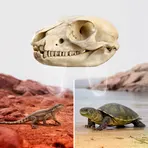
An early reptile with a skull that has no openings at the sides, now only turtles
Antonyms

Compounds
- Specialized
An early reptile with a skull that has no openings at the sides, now only turtles
Surface Forms
Morphology
anapsid = apsid (opaque) = an + apsid
The prefix 'an-' (without) is recognizable, but 'apsid' is a technical combining form unfamiliar to general learners, so the meaning is not inferable by a typical B1 learner.
Etymology
The word anapsid comes from Greek parts an- meaning 'without' and -apsid from apsis, which means 'arch' or 'opening'. So an anapsid is a reptile 'without' the side openings in its skull, as in turtles.

