
anamorphosis
- noun
- /ˌænəˈmɔrfəsɪs/
- Specialized
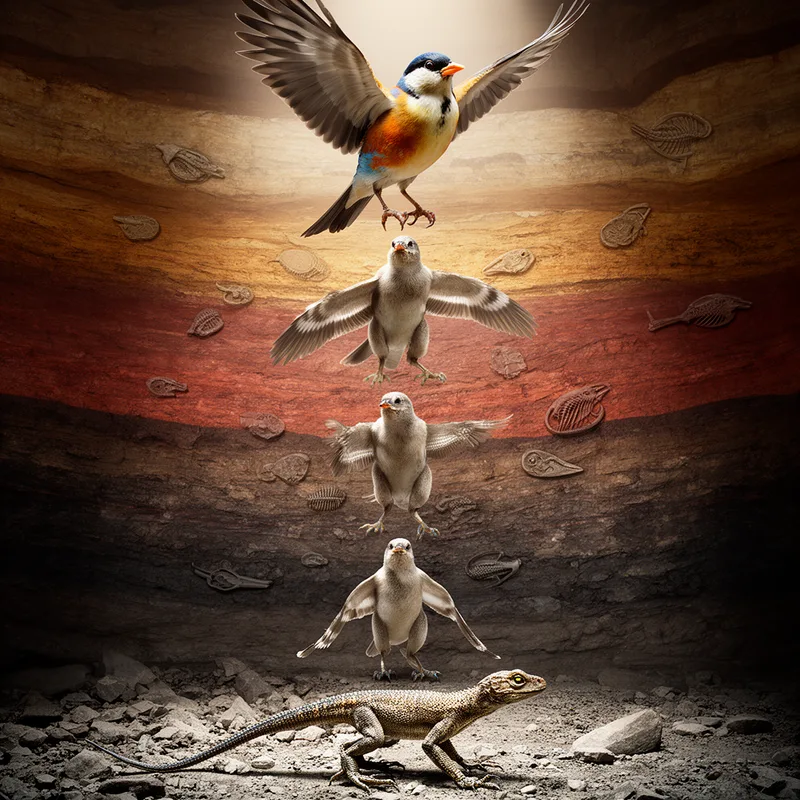
- The fossil record reveals the anamorphosis of early reptiles into birds over millions of years.
Examples
-
Researchers studied the anamorphosis evident in the transitional features of prehistoric mammals.
-
Darwin's theory explains the anamorphosis of complex life forms from simpler ancestors.
-
The concept of anamorphosis is fascinating in evolutionary biology.
-
Many species undergo anamorphosis over millions of years.
-
Darwin's theory explains the anamorphosis of complex life forms from simpler ancestors.
-
The fossil record reveals the anamorphosis of early reptiles into birds over millions of years.
-
Researchers studied the anamorphosis evident in the transitional features of prehistoric mammals.
Synonyms

 241
3.7
241
3.7

A complete change in form or appearance, for example a caterpillar becoming a butterfly
 210
4.4
210
4.4
A gradual change that makes something more advanced or complex
 4
8.3
4
8.3
A process by which new species form from existing ones
 4
4.4
4
4.4
A slow process of change and development by small steps over time
 1
9.3
1
9.3
Large changes in living things over millions of years that make new groups such as mammals

 1
4.7
1
4.7
Living things change slowly over many years to form new species
 1
6.4
1
6.4
A gradual change that makes something more advanced or complex
Slow change of a living thing into a different kind over a long time

Change in a species over time without splitting into new species
How Evolved

- Specialized
377
4.4
- Specialized
113
3.0
363
3.1
Surface Forms
Morphology
anamorphosis = anamorph (opaque) = ana + morph + osis
The meaning of 'anamorphosis' in evolutionary biology is not directly derivable from its components for most learners.
Etymology
Anamorphosis comes from Greek parts ana- ('again' or 'up') and morph ('form' or 'shape'). So, think of anamorphosis as 're-forming', a slow change in form over time that helps explain how one kind of animal becomes another.