

anamorphism
- noun
- /ˌænəˈmɔːrfɪzəm/
- Specialized
- The formation of garnet from simpler minerals is an example of anamorphism in metamorphic rocks.
Examples
-
Deep within the Earth's crust, anamorphism transforms existing rocks by creating new, more complex minerals.
-
Geologists study anamorphism to understand how mineral structures change under extreme pressure and temperature.
-
The anamorphism of minerals can create stunning geological formations.
-
The process of anamorphism transforms simple minerals into complex ones.
-
Deep within the Earth's crust, anamorphism transforms existing rocks by creating new, more complex minerals.
-
Geologists study anamorphism to understand how mineral structures change under extreme pressure and temperature.
-
The formation of garnet from simpler minerals is an example of anamorphism in metamorphic rocks.
Synonyms
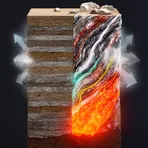
A change in rocks caused by heat, pressure, or new chemicals
Antonyms

- Specialized
Rocks near the Earth's surface change and break complex minerals into simpler ones
Surface Forms
Morphology
Etymology
The word anamorphism comes from the parts ana- meaning 'up' or 'again' and morph meaning 'form', the same 'morph' you see in metamorphosis, so imagine rocks changing 'up' into new shapes deep under the ground. That is why anamorphism describes the deep process that turns simple minerals into more complex ones.

