
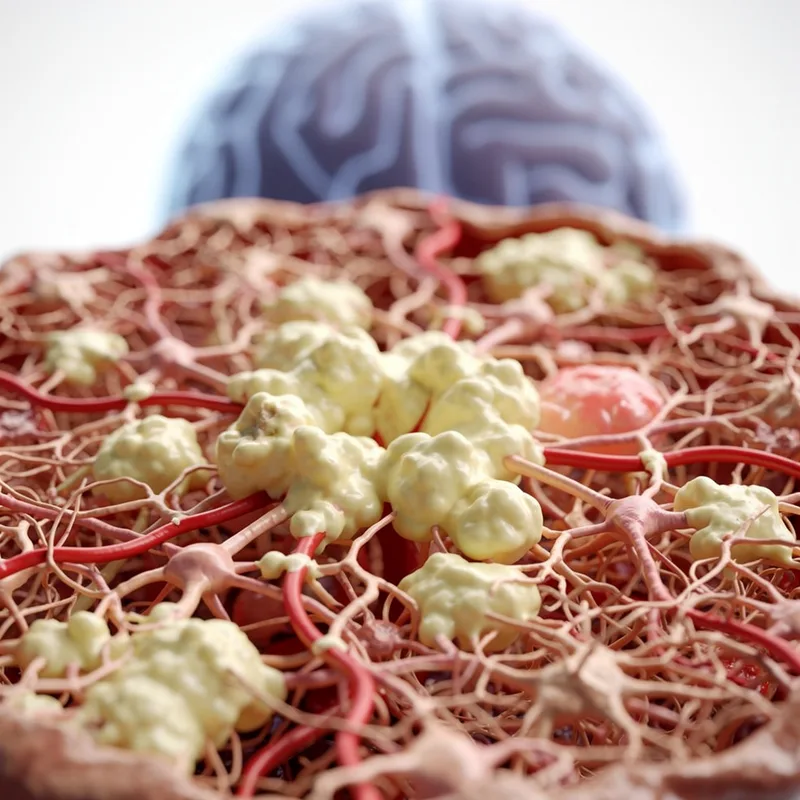
amyloid
 4
9.9
4
9.9

- noun
- /ˈæməˌlɔɪd/
- Specialized
- Importantly, the reduced amyloid burden was associated with improved cognitive function.
- Beta-amyloid
- Amyloid load
- Amyloid deposits
Loading YouTube…
Watch on YouTubeAre these two Alzheimer's proteins, amyloid and Tau protein?
- Are these two Alzheimer's proteins, amyloid and Tau protein?
- And for example, beta amyloid actually is generated from an amyloid precursor protein.
- So what we don't fully understand is exactly what does removing amyloid do?
- Flush water through its through its tissue and flush out a lot of toxins, including beta amyloid, which is associated with Alzheimer's disease.
- You can see people with massive amounts of amyloid in the brain who are still quite normal cognitively.
- And that's where things like amyloid Blake or amyloid beta, which accumulates in Alzheimer's disease, tend to be cleaned out.
- These two presence of amyloid beta and two inclusion are the hallmark and the definition of Alzheimer's disease.
- So one of the things that have been found is that there is an estradiol and hormonal regulation of of the buildup and accumulation of amyloid.
- And Biogen showed that it's drug, Adihelm reduces amyloid plaques in the brain.
- It's called ginger pan that crosses into the brain and causes the brain to lay down amyloid plaque.
- So these genes are presenol in one, presenol in two, and amyloid precursor protein, right?
- I give the example of Alzheimer's, right and, and amyloid.
Examples
-
Another report suggests that beta-amyloid accumulation in old dogs correlates with cognitive impairment.
Academic text (1995) -
In 1875, Burow was the first to describe amyloid deposits in the larynx.
Academic text (2004) -
"...various ways to prevent the production of amyloid... are being tried.
-
There is evidence of high amyloid in older people... with normal cognitive function, correct?
-
I also read that high amyloid is associated with conditions other than Alzheimer's.
-
You can see people with massive amounts of amyloid in the brain who are still quite normal cognitively.
-
All this red area here, that is amyloid plaque buildup.
-
Have you heard of beta amyloid, which is a cluster of proteins that increases your risk of Alzheimer's disease?
-
These two presence of amyloid beta and two inclusion are the hallmark and the definition of Alzheimer's disease.
-
The accumulation of amyloid in the brain is often linked to Alzheimer's disease.
Compounds

- Specialized
1
6.9
A clump of protein that builds up in the brain and is seen in Alzheimer's disease
- Specialized
A clump of protein that builds up in the brain, often in Alzheimer's disease
Surface Forms
Morphology
Etymology
Amyloid was named from Greek amylon 'starch' plus -oid 'like' because early scientists thought the deposits looked like starch. That's why the disease-related amyloid is a waxy protein that was called 'starch-like' even though it is a protein, not starch.