
amphibian
 21
4.4
21
4.4

- noun
- /æmˈfɪbiən/
- Many species of amphibians are facing extinction due to habitat loss and pollution.
- amphibian species
- threatened amphibians
- global decline in amphibians
Loading YouTube…
Watch on YouTubeAnd they're talking, of course, about mammals and birds, even amphibians and reptiles.
- And they're talking, of course, about mammals and birds, even amphibians and reptiles.
- These micro and nanoplastics and all the chemicals that they leach out are causing health problems in the amphibians and in other animals.
- She presented one of the senior partners with a live frog, and for the rest of her life that amphibian became her unlikely icon.
- Straws kill turtles and we also those are amphibians.
Examples
-
In biology class, we learned that an amphibian undergoes metamorphosis from a tadpole to an adult.
-
Unlike many other amphibians, which transform into terrestrial adults, axolotls retain their juvenile characteristics and never leave the water.
-
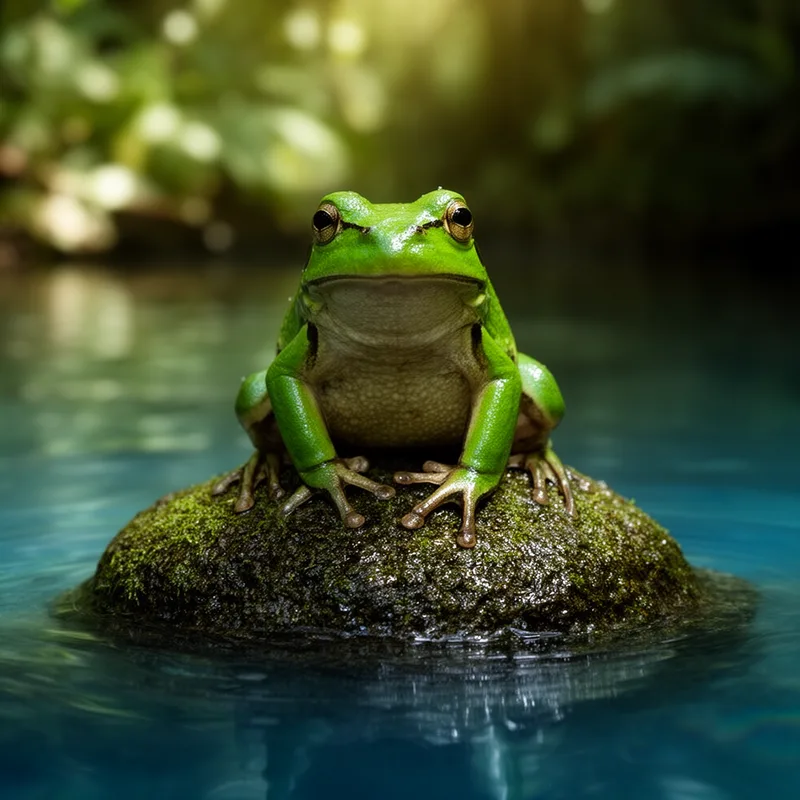
- Here is a prime example of the amphibian family, the frog.
-
Sometimes, while conducting field research on amphibians, my hearing has played tricks on me.
Academic text (1998) -
Amphibians gave way to reptiles... who ruled the earth for millions of years.
-
John C. Murphy retired from a teaching career to focus on amphibians, reptiles, and photography.
Blog text (21) -
Frogs, salamanders, snakes, turtles, lizards, and other amphibians and reptiles, plus diverse insects, are among the Green Wedge's wild inhabitants.
Academic text (2003) -
The frog is a well-known amphibian that can live both in water and on land.
How Aquatic

Surface Forms
Morphology
amphibian = amphibious (semi-transparent) = amphib + an
Formally related to 'amphibious' via a standard adjectival/noun suffix '-an', but the Greek combining element 'amphib-' ('both' + 'life') is not familiar to many learners.
Etymology
Amphibian comes from Greek parts amphi- meaning 'both' and bio meaning 'life', as in biology. So an amphibian is an animal that lives 'both' in water and on land.