
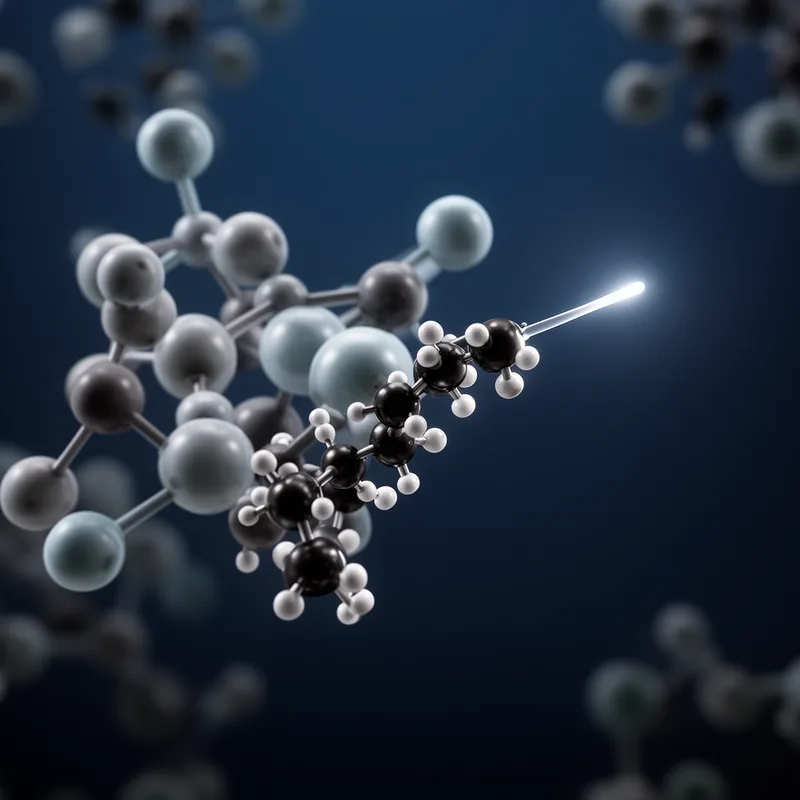
alkyl radical
- noun
- /ˈæl.kɪl ˈræd.ɪ.kəl/
- Specialized
- The methyl group is the simplest alkyl radical and is commonly found in organic compounds.
Examples
-
Combustion reactions often involve the formation and breakdown of alkyl radicals.
-
Researchers studied the reactivity of a newly synthesized alkyl radical in the laboratory.
-
An alkyl radical is crucial in organic chemistry.
-
The alkyl radicals formed during the reaction were analyzed.
-
The methyl group is the simplest alkyl radical and plays an important role in organic chemistry.
-
Researchers studied the reactivity of a newly synthesized alkyl radical in their experiments.
-
Combustion reactions often lead to the formation of alkyl radicals, which can participate in further chemical processes.
Synonyms


 1
9.9
1
9.9
A part of a molecule made of carbon and hydrogen in a chain

A part of a molecule made of carbon and hydrogen atoms with one hydrogen removed
Surface Forms
Morphology
This is a compositional noun–noun compound: 'alkyl' names a specific hydrocarbon group and 'radical' names a reactive chemical species, so the phrase denotes a radical that is of the alkyl type. Even though the terms are technical, the overall meaning is directly derivable from the constituents and follows a transparent modifier–head pattern common in scientific vocabulary.
Etymology
Alkyl radical comes from alkyl (a small carbon 'branch' from a larger molecule) and radical (originally a 'root' or broken-off part). Imagine a branch cut from a tree with one lonely electron like a loose hand that grabs quickly; an alkyl radical is a small carbon fragment that reacts fast, so the name reminds you it is 'broken-off and grabby'.