
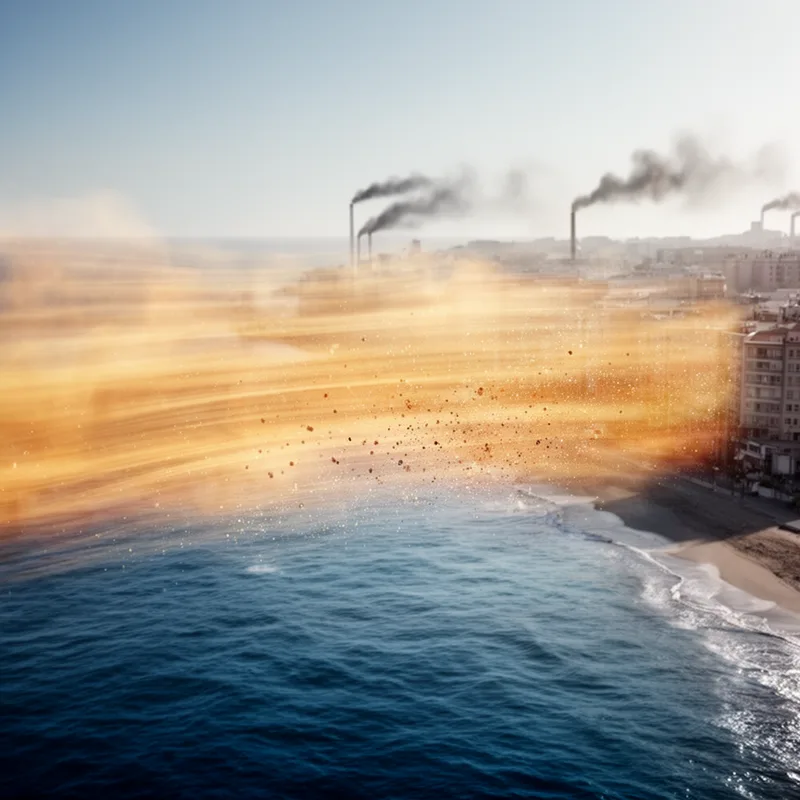
to advect


 1
9.9
- verb
- /ædˈvɛkt/
- Specialized
- In meteorology, models simulate how pollutants are advected by currents, affecting air quality in coastal cities.
Examples
-
For a big snow event, persistent high pressure located in Northern Scandinavia advects polar and sub-arctic air across the North Sea.
Blog text (14) -
It tracks the changing velocity of individual particles along their paths as they are advected by the flow.
Academic text (2012) -
This term, as we know doesn't smooth the solution just can just advect it just carries it along.
-
The convection process is maintained by a continuous supply of shallow water advected from tropical regions.
Academic text (2002) -
Lidar observations at UMBC show a cloud-capped boundary layer, with clouds advecting during our operation.
Blog text (9) -
This result suggests that the extra downwelled water is advected all the way up to the North Atlantic, where it becomes dense, sinks in the usual way, and then flows back to the south as a deep current.
Academic text (1994) -
The katabatic winds warm adiabatically as they descend from the ice sheet, whereas the coastal breezes tend to be cool as they advect into the valley from the ice-covered McMurdo Sound.
Academic text (1999) -
The NCAR simulation is fantastic and very instructive on what happens to a tropical hurricane as it gets advected into a cold upper trough, thus collapsing the warm core and unspooling the surface pressure gradients.
Blog text (14) -
The wind can advect warm air into colder regions, causing changes in temperature and weather patterns.
-
Ocean currents advect warmer water from the equator toward the poles, influencing climate across the globe.
Antonyms

How Moved

Surface Forms
Morphology
advect = vect (opaque) = ad + vect
'Vect' is not a standalone English word, so the meaning is not transparently available to learners.
Etymology
Advect comes from Latin parts ad- ('to' or 'toward') and vehere ('to carry'), the same root you see in vehicle and convey. So, advect means to be 'carried toward' by moving air or water, as when wind or currents move heat, moisture, or pollution across a region.