
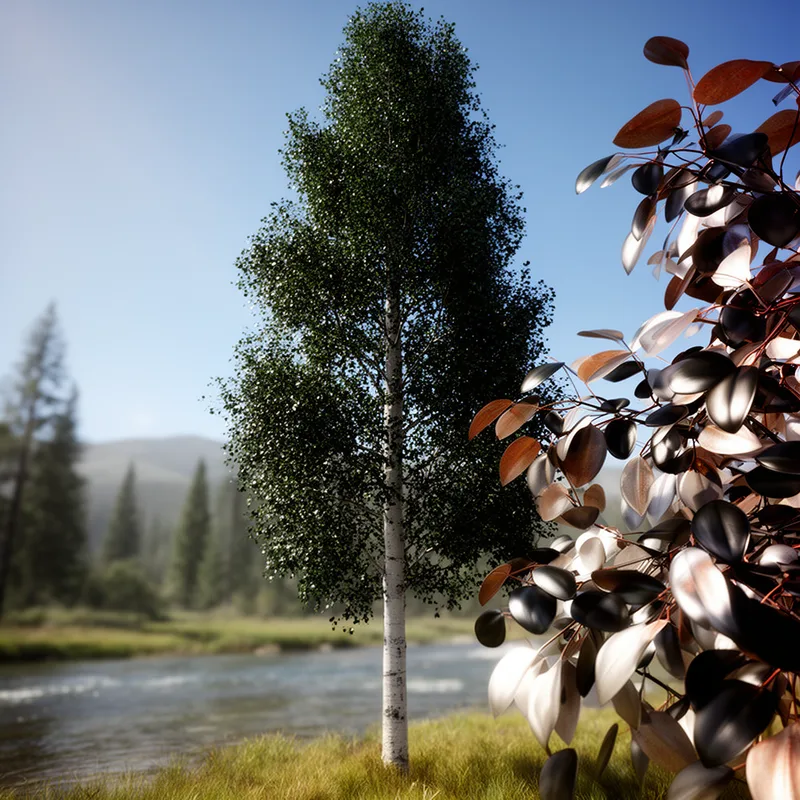
Western balsam poplar
- noun
- Specialized
- The Western balsam poplar thrives along riverbanks and in moist lowlands across western Canada and the United States.
Examples
-
You can easily identify a Western balsam poplar by checking for silvery undersides on its leaves.
-
In spring, the leaves of the Western balsam poplar shimmer in the sunlight due to their glossy surface.
-
The Western balsam poplar is known for its unique leaves.
-
Many Western balsam poplars grow along the riverbanks.
-
The Western balsam poplar is a popular choice for landscaping due to its attractive foliage.
-
During the summer, the Western balsam poplar provides shade with its broad, dark green leaves.
-
Birds often nest in the branches of the Western balsam poplar, taking advantage of its dense foliage.
Synonyms

 15
5.1
15
5.1

A large North American tree with soft wood and seeds with cottony hairs
 9
4.4
9
4.4
A tall tree with light wood and small hanging flowers that grows in cool areas
 2
3.0
2
3.0
A tall tree that grows quickly with light wood and long hanging catkins
A large tree that grows in western North America with shiny green leaves and silvery or rusty undersides
A tree with broad heart-shaped leaves and sticky buds that smell sweet
Surface Forms
Morphology
The phrase describes a type of poplar tree characterized by balsam-like qualities and associated with the western region; a learner who knows 'western', 'balsam', and 'poplar' can readily infer it refers to a western poplar with balsam characteristics. This is a fully compositional, descriptive noun phrase following common adjective+noun patterns found cross-linguistically, so its meaning is immediately derivable from its parts.
Etymology
Western balsam poplar comes from the parts of the name: Western shows it grows in the west, balsam refers to the sticky, scented 'sap' in its buds, and poplar is the kind of tree. So the name points to a poplar tree from the west with balsam-scented sap and shiny, silvery leaves.