
Vitruvian
 1
9.9

- adjective
- /vɪˈtruːviən/
- Formal
- The Renaissance and the image of the Vitruvian man who "squares the circle" (most people know Leonardo's version of this, but it was everywhere) described the profound value of the human soul that had a reach beyond the four-directioned square of Earth and the endless circle of spiritual Heaven.
Examples
-
That this silhouette appears within a symmetrical shape, arms and legs outward, alludes to Leonardo da Vinci's drawing of the "Vitruvian Man," an image frequently used to represent health and physical perfection.
Academic text (2014) -
They drew inspiration from Stanislavski's interpretation of the Vitruvian influence on the Spanish Laws of the Indies, yet pointed out that Vitruvius himself never explicitly recommended a grid layout, preferring a radial plan instead.
Academic text (2008) -
Athos and the Vitruvian Body
Academic text (2005) -
ROBERT: The Vitruvian Man.
-
Vitruvian man
Academic text (1992) -
Nature turned into spectacle, miracle into wonder, the Vitruvian man into the apotheosis of egotism.
Academic text (2005) -
BJ's Vitruvian man listening to an iPod made us chuckle, and we liked the layering of photography and illustration.
Blog text (8) -
Photo (black and white): Fig 1 -- Leonardo da Vinci, c. 1487: Vitruvian Man within a circle.
Academic text (1992) -
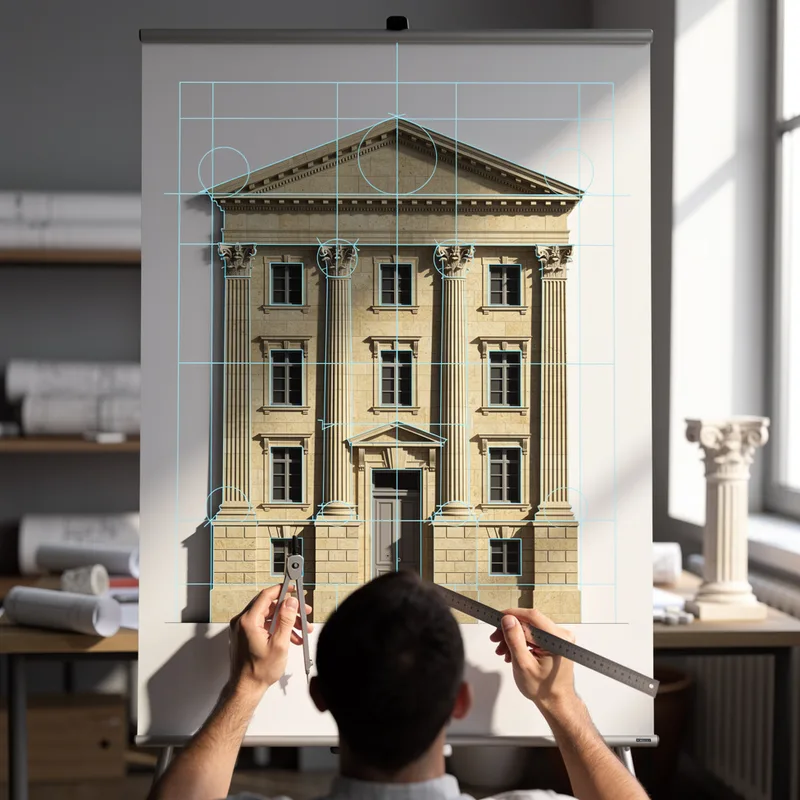
The architect designed the building with a Vitruvian approach, emphasizing harmony and proportion.
-
Her style is influenced by Vitruvian principles, focusing on balance and symmetry in her designs.
Surface Forms
Morphology
Vitruvian = Vitruvius (semi-transparent) = Vitruvius + ian
The word transparently combines the proper name Vitruvius with the relational suffix -ian, though the base name may be unfamiliar to many learners.
Etymology
Vitruvian comes from the Roman architect Vitruvius, who taught that buildings should have the right 'proportion' and 'balance'. So when architects call a design 'Vitruvian' they mean it follows his ideas of symmetry and correct proportions.