

Vesuvius
 9
6.5
9
6.5

- proper noun
- /vəˈsuːviəs/
- In A.D. 79, Mount Vesuvius, overlooking Italy's Bay of Naples, erupted for two days, burying Pompeii beneath ash and pumice.
- Mount Vesuvius
- eruption of Vesuvius
- Vesuvius and Pompeii
Loading YouTube…
Watch on YouTubeAnd there's a shrine from an atrium in Pompeii, which shows Mount Vesuvius.
- And there's a shrine from an atrium in Pompeii, which shows Mount Vesuvius.
- The rich man heads to Vesuvius and doesn't notice the maternal height, the high Andean flame.
- And I asked the host if they could find me a singer who lived on Mount Vesuvius.
Examples
-
PHOTOS (COLOR): Above: View of Mount Vesuvius from the south end of the Forum in Pompeii.
Academic text (2003) -
In A.D. 62, a large earthquake is known to have hit Pompeii, 17 years before Vesuvius buried it in ash.
Academic text (2010) -
But Hamilton did not just look at Vesuvius and pay others to do so for him.
Academic text (2010) -
I'm taking Lily to Vesuvius.
-
Build your cities on the slopes of Vesuvius!
-
That is a picture of Mount Vesuvius in eruption, which gives you an idea of the impact that our new television show is going to have.
-
Sir William and his first wife Catherine lived quietly at Portici, with Vesuvius an entertaining feature in their view.
Academic text (2010) -
Piaggio, who lived at the foot of Vesuvius, 'always rose at daybreak and took his observations several times in the day.'
Academic text (2010) -
The eruption of Vesuvius in A.D. 79 left a thick layer of ash over the ancient cities of Pompeii and Herculaneum.
-
Tourists flock to see Vesuvius, eager to learn about its history and the events of the catastrophic eruption.
Synonyms


 1
4.4
1
4.4
A volcano near Naples in southern Italy famous for its AD 79 eruption that buried Pompeii and Herculaneum
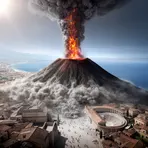
A volcano in southwest Italy that buried Pompeii and Herculaneum in AD 79
Compounds
1
4.4
A volcano near Naples in southern Italy famous for its AD 79 eruption that buried Pompeii and Herculaneum
Surface Forms
Etymology
Vesuvius probably comes from an old local word vesu- meaning 'smoke' or 'burn', so a helpful way to remember it is to think of it as 'the burning one'. That's why the name fits a volcano that once erupted and buried nearby towns.