
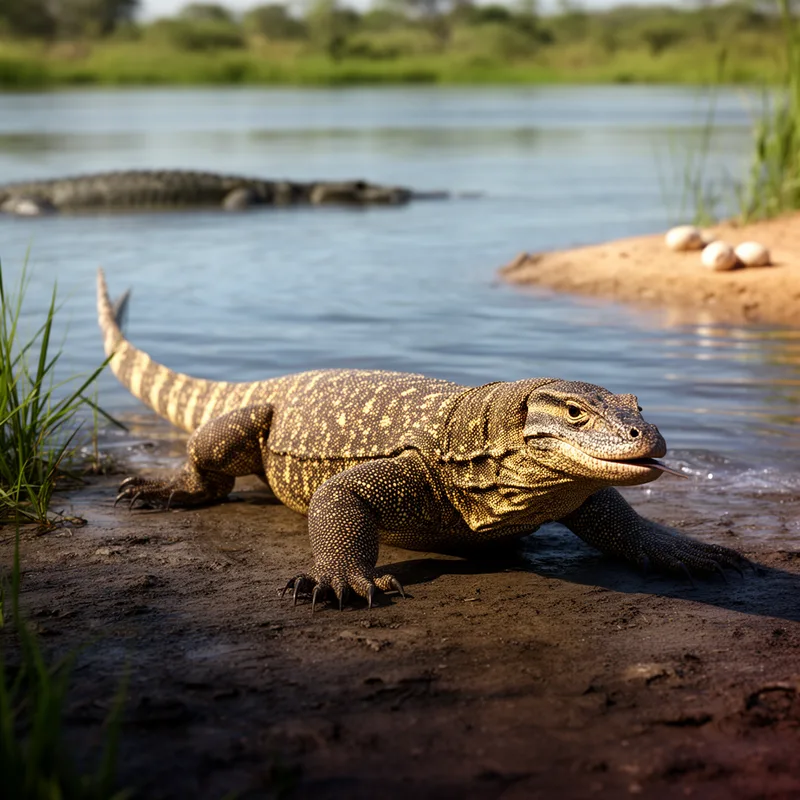
Varanus niloticus
- noun
- Specialized
- The Varanus niloticus is often seen basking on riverbanks in sub-Saharan Africa.
Examples
-
The Varanus niloticus is known for preying on crocodile eggs in the wild.
-
The Varanus niloticus is often found near water sources.
-
Researchers tracked the movements of several Varanus niloticus to study their migration habits.
-
Look at that Varanus niloticus!
-
Researchers tracked the movements of several Varanus niloticus to study their migration habits.
-
The Varanus niloticus is known for preying on crocodile eggs in the wild.
-
The Varanus niloticus is often seen basking on riverbanks in sub-Saharan Africa.
Synonyms

 2
9.1
2
9.1

A large tropical lizard that eats meat and has a long tail
 1
6.1
1
6.1
A large lizard from hot regions like Africa, Asia and Australia that eats meat
A large lizard that lives in hot places and hunts birds and mice
Surface Forms
Morphology
Varanus + niloticus
This is a Linnaean binomial combining a genus name (Varanus, monitor lizard) with a Latin species epithet (niloticus, ‘of the Nile’). If a learner actually knows both constituents and recognises the Latin epithet, the meaning (‘Nile monitor’) is derivable, but the epithet is specialized Latin and not transparently comprehensible to a typical B1 learner. Because the name is technical and requires domain/Latin knowledge, it is only partially transparent.
Etymology
Varanus niloticus gets its name from two parts: Varanus, which may come from an old word meaning 'monitor' because these big lizards often stand on riverbanks and seem to watch like guards, and niloticus, which means 'from the Nile'. So the name helps you remember a large river lizard that watches its surroundings and lives by the Nile.