
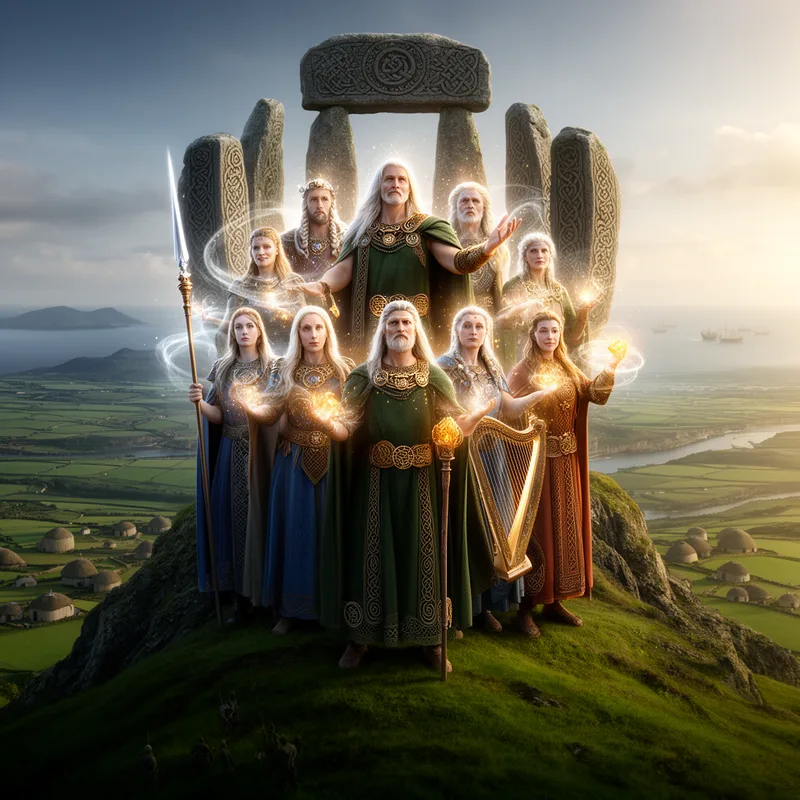
Tuatha De Danann


 1
9.9
- proper noun
- Literature
- In Irish mythology, the Tuatha De Danann are celebrated as the rulers of Ireland during the Golden Age.
Examples
-
Similarly, the Tuatha De Danann queen, Eire, changes shape when she is fighting the enemy Milesians.
Academic text (2000) -
In the Battle of Moytura, the Morrigan helped the ancient Irish Tuatha De Danann to defeat their enemy, the Fomorians.
Academic text (2000) -
They came to a dwelling where they met a phantom who happened to be Lugh, god of the ancient magical folk the Tuatha De Danann, the people of the goddess Danu.
Academic text (2000) -
Legend has it that the Tuatha De Danann possessed great powers and magical abilities.
-
The tales of the Tuatha De Danann highlight their significance in ancient Irish folklore.
Synonyms
 1
9.9
A group of Irish gods and demigods who rule Ireland in old stories
Surface Forms
Morphology
tuath + De + Danann
This is a Gaelic proper name composed of non-English elements; two constituents ('De', 'Danann') are not standard English words and the cultural/mythological sense (‘deities’) is not transparently derivable. Even if a learner knew 'tuath' = people/clan, the full meaning 'a group of deities' depends on specific cultural knowledge of Irish mythology, so a B1 learner would not reliably infer it from the parts.
Etymology
Tuatha De Danann comes from old Irish words: Tuatha means 'people' and De Danann means 'of the goddess Danu', and one popular story says it names a magical people who once ruled Ireland. That's why Tuatha De Danann refers today to a group of powerful, magical beings — like 'gods' or 'demigods' — in old Irish stories.