
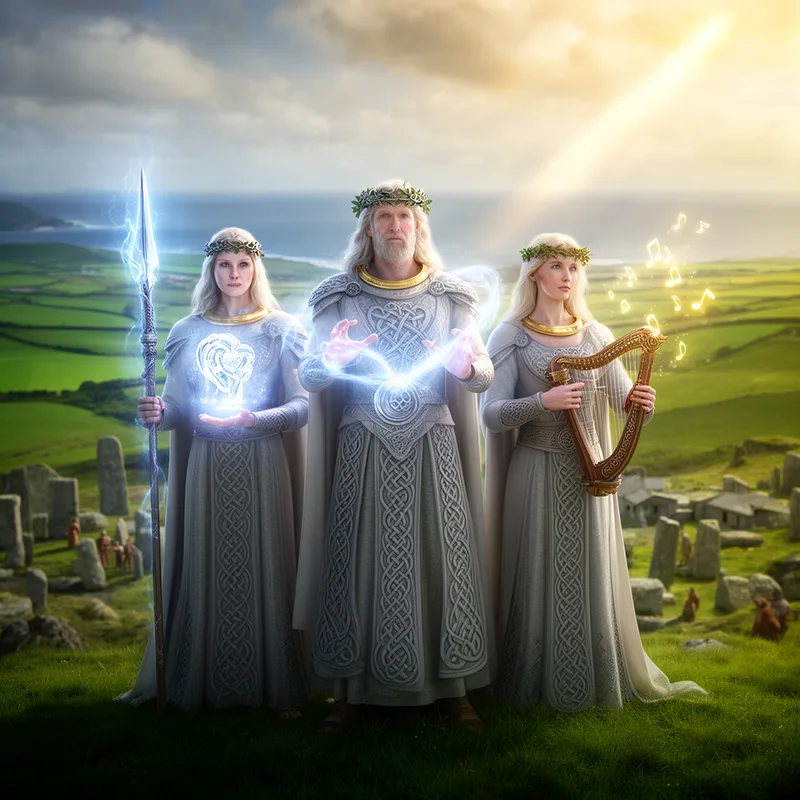
Tuatha De


 1
9.9
- noun
- /ˈtuːəθə deɪ/
- Literature
- In the Battle of Moytura, the Morrigan helped the ancient Irish Tuatha De Danann to defeat their enemy, the Fomorians.
- Tuatha De Danann
Examples
-
In Irish mythology, the Tuatha De were revered as powerful gods who ruled during a time of prosperity.
-
Similarly, the Tuatha De Danann queen, Eire, changes shape when she is fighting the enemy Milesians.
Academic text (2000) -
In sleeping with the Dagda, the Morrigan imbued him with her divine energy, and he was enabled to lead the Tuatha De to victory.
Academic text (2000) -
They came to a dwelling where they met a phantom who happened to be Lugh, god of the ancient magical folk the Tuatha De Danann, the people of the goddess Danu.
Academic text (2000) -
The ancient stories tell of the Tuatha De and their magical abilities that shaped the landscape of Ireland.
-
According to legend, the Tuatha De were skilled in art and war, making them formidable rulers in their Golden Age.
Synonyms
 1
9.9
A group of gods and magical people in old Irish stories who once ruled Ireland
Surface Forms
Morphology
tuath + De
The first element 'tuath' clearly means a people or clan, so there is partial compositionality suggesting a group; if 'De' were known as 'gods' the phrase would literally mean 'people of the gods'. However 'De' has no dictionary entry here and the term is a culture-specific proper name from Irish mythology whose exact mythic sense (Celtic gods/demigods) is not fully predictable for an average B1 learner, so overall it is only partially transparent.
Etymology
Tuatha De comes from old Irish words: Tuatha meaning 'people' or 'tribe' and De meaning 'gods', so it literally means 'people of the gods'. That's why the name refers to a group of gods or demigods in old stories who were said to rule Ireland.