
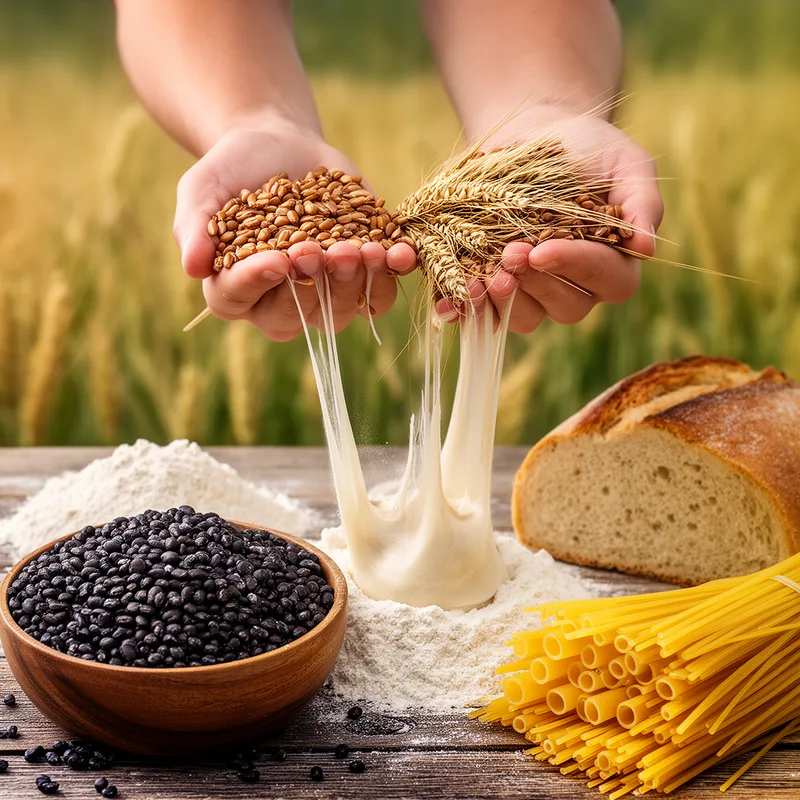
Triticum turgidum
- noun
- Specialized
- Many pasta brands use flour made from Triticum turgidum because of its high gluten content, which gives the noodles a firm texture.
Examples
-
Farmers in southern Russia grow Triticum turgidum for its high gluten content.
-
Researchers are studying Triticum turgidum for its high gluten content and suitability for different culinary uses.
-
Triticum turgidum is an important crop for regions that rely on pasta and bread as dietary staples.
-
Farmers in North America have increased the cultivation of Triticum turgidum due to its resilience in varying climates.
-
Did you know that Triticum turgidum is often used in pasta?
-
Triticum turgidum, commonly known as durum wheat, is widely cultivated in regions where pasta and bread are dietary staples.
-
In southern Russia, farmers grow Triticum turgidum for its ability to thrive in dry soil conditions.
Synonyms


 1
3.7
1
3.7
A grain with hard, dark seeds used to make bread and pasta

A hard type of wheat with dark grains used to make pasta and bread
Surface Forms
Morphology
Triticum + turgidum
This is a Latin binomial (genus + species) rather than a compositional English phrase; an average B1 learner who knows the listed constituents would not be able to derive the specific meaning 'a species of wheat' because 'turgidum' is not an English word and 'Triticum' is technical. Biological naming conventions are systematic but require specialist knowledge, so the expression is not transparently interpretable by general learners.
Etymology
Triticum turgidum comes from Latin: Triticum means 'wheat' and turgidum means 'swollen', giving the image of plump, hard kernels. That's why the name fits this wheat, which has firm grains that make strong dough for 'pasta' and 'bread'.