
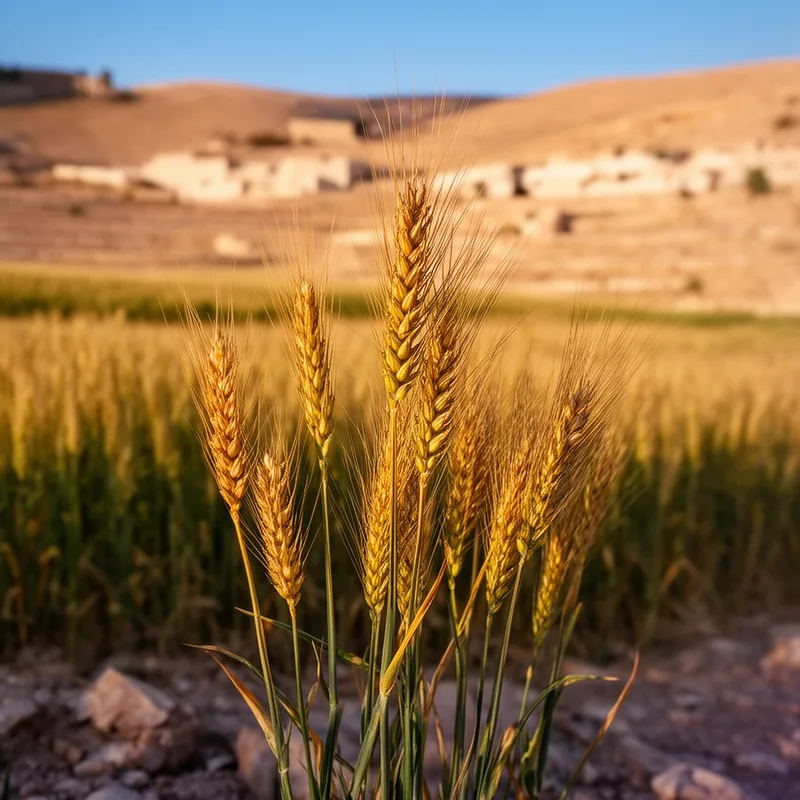
Triticum dicoccum dicoccoides
- noun
- Specialized
- Triticum dicoccum dicoccoides is thought to be the direct wild ancestor of modern wheat varieties.
Examples
-
Archaeobotanists discovered remains of Triticum dicoccum dicoccoides in ancient settlements in the Levant.
-
The Triticum dicoccum dicoccoides is often studied for its genetic traits.
-
Research into Triticum dicoccum dicoccoides offers insights into early agricultural practices.
-
Farmers in the Middle East grow Triticum dicoccum dicoccoides for its resilience.
-
Triticum dicoccum dicoccoides is believed to be the ancestor of various cultivated wheat varieties that we use today.
-
In their research, scientists analyzed samples of Triticum dicoccum dicoccoides to understand its role in agriculture's history.
-
The ancient grains of Triticum dicoccum dicoccoides found in archaeological sites provide valuable information about early farming techniques.
Synonyms
A wild type of wheat that is the ancestor of farm wheat
Surface Forms
Morphology
Triticum + dicoccum + dicoccoides
This is a Latin binomial: knowing 'Triticum' (a genus of grasses/wheat) lets a learner infer the term refers to a type of wheat or grass, but the specific senses carried by 'dicoccum' and 'dicoccoides' are not transparent dictionary words and do not yield the detailed meaning (wild emmer, Middle Eastern ancestor). Because only the genus component gives partial information while the rest remains opaque, a B1 learner would only partially infer the meaning.
Etymology
Triticum dicoccum dicoccoides grew as a wild emmer wheat on hills in the ancient Middle East, where people gathered its seeds and planted them. Over time they chose the best plants and turned them into farmed 'wheat', so this wild plant is called the 'ancestor' of modern wheat.

