

Trialeurodes vaporariorum
- noun
- Specialized
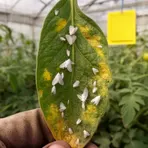
- Trialeurodes vaporariorum can cause serious damage to tomato plants in greenhouses.
Examples
-
Biological control methods are often used to reduce Trialeurodes vaporariorum populations.
-
The spread of Trialeurodes vaporariorum has increased due to international trade in greenhouse plants.
-
The Trialeurodes vaporariorum is a common pest in greenhouses.
-
Farmers must control Trialeurodes vaporariorum to protect their crops.
-
Trialeurodes vaporariorum can cause serious damage to tomato plants in greenhouses.
-
Farmers must control Trialeurodes vaporariorum to protect their crops.
-
The spread of Trialeurodes vaporariorum has increased due to international trade in greenhouse plants.
Synonyms


 1
8.1
1
8.1
A small white insect that sucks sap from plants and damages them

A small white insect that lives in greenhouses and eats plant sap
Surface Forms
Morphology
Trialeurodes + vaporariorum
This is a Latin binomial (scientific name) composed of taxonomic labels rather than a compositional English phrase; the second element is a Latin species epithet (not an ordinary English word and here listed as not found in dictionaries). Even a learner who knew the constituent labels would not reliably infer the everyday meaning 'greenhouse whitefly' because scientific names are lexicalized labels, not transparent compound meanings.
Etymology
Trialeurodes vaporariorum comes from old Greek and Latin words that paint a simple picture: Trialeurodes may come from a word meaning 'flour' because the tiny white insects look like dust, and vaporariorum means 'greenhouse' or 'hot house' in Latin. So the name literally shows a small white, dust-like fly that lives in greenhouses, which is why we call it the 'greenhouse whitefly'.