

Swiss cheese
 5
1.3
5
1.3

- noun
- /swɪs tʃiz/
- Diced ham and shredded Swiss cheese.
- shredded Swiss cheese
- sliced Swiss cheese
- grated Swiss cheese
Loading YouTube…
Watch on YouTubeIt has Swiss cheese, horseradish, maybe something else.
- It has Swiss cheese, horseradish, maybe something else.
- I see myself as a big block of Swiss cheese.
- Turkey with, like, you give me some Swiss cheese.
Examples
-
The French dip was excellent as well and is made with Swiss cheese, caramelized onions, and mayonnaise.
Blog text (23) -
There's some Swiss cheese upstairs, go check it out.
-
A block of Swiss cheese.
Fiction book (2001) -
A nice Swiss-cheese sandwich, perhaps?
-
I'm having a ham and Swiss cheese omelette.
-
I need two pounds of ham and a pound of Swiss cheese sliced up.
-
He put the light toast on a plate, heaped the tuna mix on the toast, and spread Swiss cheese on the tuna.
Fiction book (1994) -
You can also get your pretzel topped with pork schnitzel, cabbage-apple slaw, and Swiss cheese.
Blog text (21) -
Westin Casuarina Resort & Spa, Grand Cayman: The classic club sandwich is made with grilled chicken breast, and Swiss cheese is added for a tangy touch.
Blog text (15) -
I'm having a ham and Swiss cheese omelette.
Synonyms
 ∞
1.0
∞
1.0
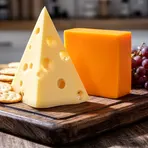
A solid food made from milk that is pressed and often aged
 2
4.6
2
4.6
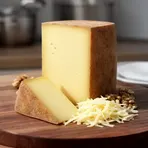
A firm pale yellow Swiss cheese with a nutty taste
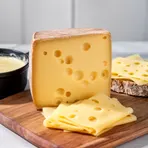
A hard yellow Swiss cheese with large holes and a mild nutty taste
Surface Forms
Morphology
The meaning 'a cheese from Switzerland' is directly and transparently derived from combining 'Swiss' (from Switzerland) and 'cheese' (a dairy product). This adjective+noun compositional pattern is cross-linguistically common and follows standard English phrase formation, so a B1 learner who knows both constituents will understand the MWE.
Etymology
Swiss cheese may come from how cheese makers in Switzerland made a pale yellow cheese with round holes called 'eyes'. Those holes were formed when tiny living things in the cheese made gas as it aged, so today Swiss cheese means the kind of cheese known for its holes.