
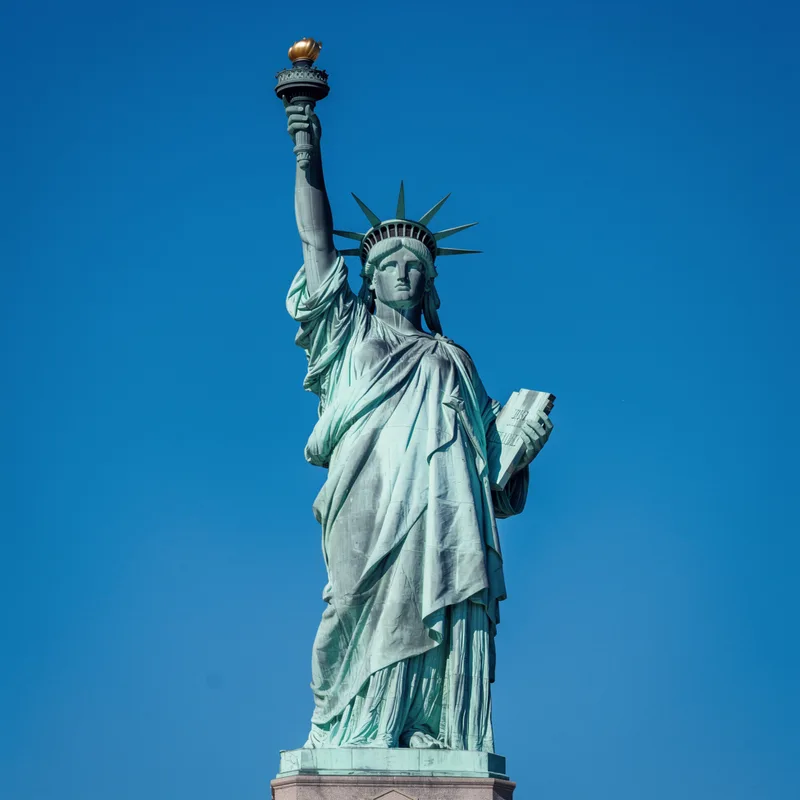
Statue of Liberty
 29
2.1
29
2.1

- proper noun
- /ˈstætʃu əv ˈlɪbərti/
- When visiting New York City, you can't miss the Statue of Liberty, which stands tall in the harbor.
- sight of the Statue of Liberty
- Shadow of the Statue of Liberty
- overlooking the Statue of Liberty
Loading YouTube…
Watch on YouTubeThis Dome is taller than the Statue of Liberty.
- This Dome is taller than the Statue of Liberty.
- They would stretch from the toe to the crown of the Statue of Liberty.
- Dave Edgars wrote a children's book called Her Right Foot about the Statue of Liberty.
- And if we had just called all of that off and prove to the world that we are what the Statue of Liberty says that we are.
- And the foreign born Statue of Liberty is still the single evidence of American democracy in physical form.
- And every time we would get to the Statue of Liberty, he would tell the pilot circle the lady right Swiss circling the Statue of Liberty.
Examples
-
The Statue of Liberty says, "Give me your tired, your poor," not, "Your wealthy, your gifted, and your endowed."
-
I've always wanted to see the Statue of Liberty.
-
You know, the Statue of Liberty was a gift from France.
-
I can see the Statue of Liberty already.
-
Oh, look, the Statue of Liberty.
-
"Tomorrow, we're going to see the Statue of Liberty, right, Mom?"
Fiction book (1993) -
The first time we took the ferry, we visited the Statue of Liberty.
Fiction book (1990) -
To the south, the Statue of Liberty stood tall against the sweltering heat.
Fiction book (1995) -
You can see Manhattan, the Statue of Liberty, the Empire State Building, all from Dover.
Fiction book (1993) -
America honors the Statue of Liberty's centennial by minting United States Liberty Coins.
Surface Forms
Morphology
The phrase is fully compositional: 'statue' (a large figure) + 'of' + 'liberty' (freedom) yields a statue representing liberty, so a learner who knows the constituents can infer it denotes a monument symbolizing freedom. Although it is also a specific proper name for the New York monument, that specific referent and location are additional encyclopedic facts; the basic meaning is transparently derived and cross-linguistically paralleled (e.g. French 'Statue de la Liberté').
Etymology
The Statue of Liberty was a gift from France showing a large woman holding a torch and a book, with broken chains at her feet. She was made to represent 'freedom' and friendship, so today the Statue of Liberty is a symbol of 'freedom' and a 'welcome' to people arriving in the United States.