

St. Paul
 1
5.7
1
5.7

- proper noun
- /seɪnt pɔl/
- In a letter to the Romans, St. Paul mentions "the church that is in their house," and numerous other early writers cite homes where congregations met.
- Church of St. Paul
Examples
-
We were the first Christians in Europe—when St. Paul went out on missions, his first station was here in Dardania.
Academic text (2007) -
St. Paul traveled extensively to spread the message of Christianity to new communities.
-
St. Paul says we each have a place in Christ's Body.
Blog text (7) -
It is not because Jesus and St. Paul had different sexual moral teachings.
Blog text (14) -
This confirms the teaching of St. Paul: "Wilt thou then not be afraid of the power?
Academic text (1996) -
Because Christians in North America fail to share the Eucharist with other Christians, I venture the guess that St. Paul, were he here today, would be no less critical of us than when he wrote to the Corinthian Christians.
Academic text (2002) -
In his letters, St. Paul emphasized love and faith as the foundations of Christian life.
-
Many people study the teachings of St. Paul to better understand early Christian theology.
Synonyms
 ∞
3.0
∞
3.0
A Christian leader in the New Testament who taught many people and wrote letters to churches
 15
6.1
15
6.1
The original name of Paul, a Christian leader
 1
7.2
1
7.2
A Christian leader who taught non-Jewish people and wrote letters to early churches


 1
3.6
1
3.6
A Christian leader who taught people about Jesus and wrote letters in the New Testament

A Christian leader from long ago who wrote many letters in the New Testament

The original name of Paul the Apostle, an early Christian missionary and writer
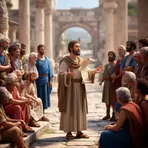
A title for Saint Paul, a Christian leader who spreads Christianity to non-Jewish people
Surface Forms
Morphology
St. + Paul
If a learner knows that 'St.' is an abbreviation for 'Saint' and 'Paul' is a personal name, then the meaning — a saint (Christian figure) called Paul — is directly derivable from the constituents. The honorific + name pattern is cross-linguistically common, so the referential meaning is transparent even if detailed historical facts (apostle, epistles) require extra knowledge.
Etymology
St. Paul was first called Saul, but after he saw a bright light on the road to Damascus he changed his beliefs and became known as Paul. That's why we call him 'St. Paul' and remember him as the follower who helped spread Christianity and wrote many New Testament letters.